 Image 1 of 1
Algebra I A Hands-On, Discussion-Based High School Algebra Curriculum for Homeschool & Co-op Students
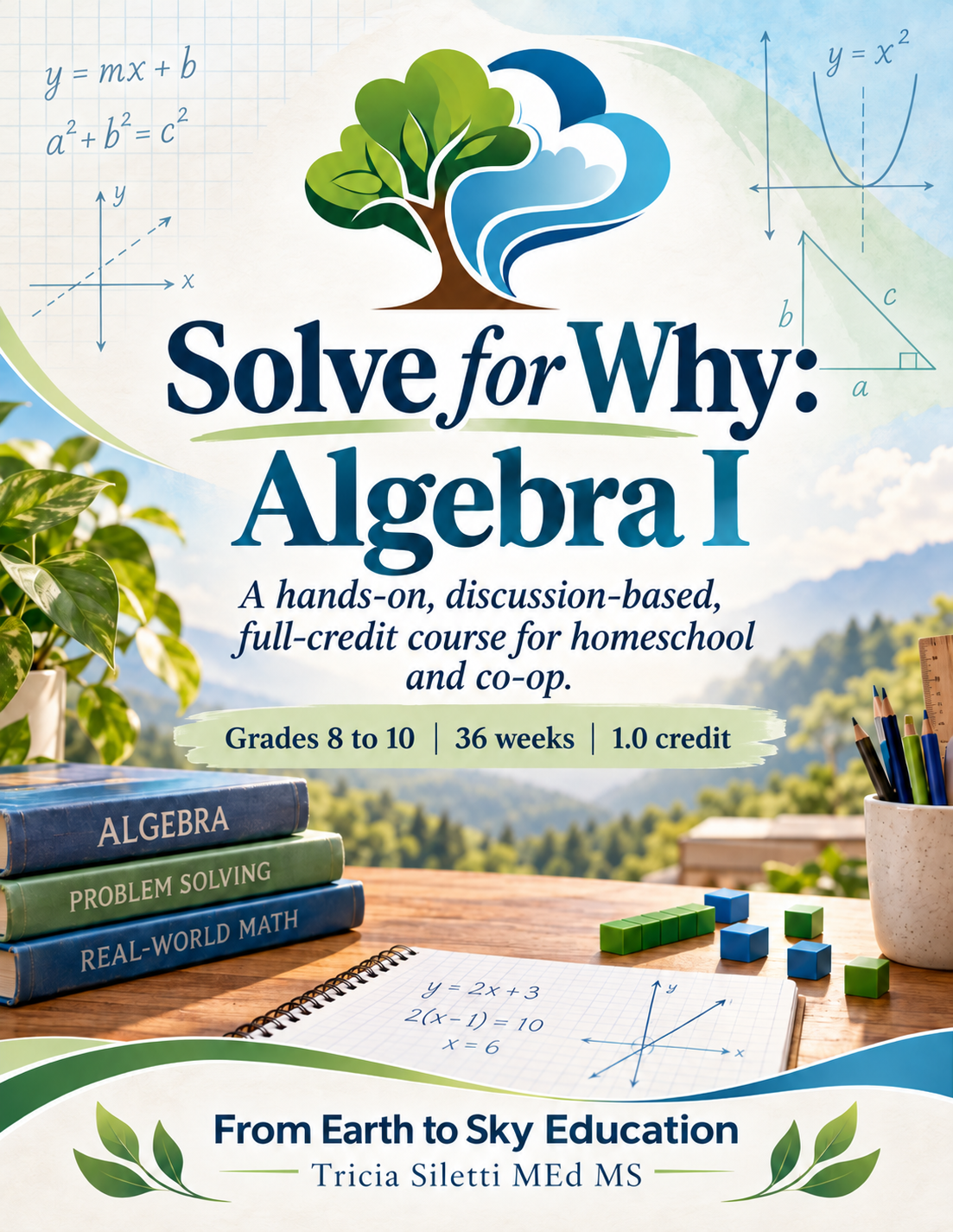
Solve for Why: Algebra I
A Hands-On, Discussion-Based High School Algebra Curriculum for Homeschool & Co-op Students
Grades 8–10 | 36 Weeks | 1.0 High School Math Credit | Facilitator Guide + Student Workbook
Created by Tricia Siletti, MEd, MS | From Earth to Sky Education
Algebra Isn't Just About Solving for X. It's About Understanding WHY.
What if your teenager could learn Algebra I through hands-on experiments, real-world problem-solving, creative projects, mathematical investigations, and meaningful discussions instead of endless worksheets, memorized formulas, and traditional tests?
Solve for Why: Algebra I is a complete, 36-week, full-credit homeschool Algebra I curriculum designed for middle school and high school students in grades 8–10. This innovative, inquiry-based mathematics program transforms abstract algebra concepts into engaging, real-life learning experiences that encourage curiosity, critical thinking, mathematical reasoning, and genuine understanding.
Designed specifically for homeschool families, homeschool co-ops, micro-schools, and alternative education programs, Solve for Why combines hands-on math activities, project-based learning, Socratic discussions, creative challenges, and mastery-based assessment into one comprehensive high school mathematics course.
Students don't simply memorize how to solve equations. They discover why equations work, how mathematical patterns shape the world, and where algebra appears in everyday life.
No traditional tests. No endless drill-and-kill worksheets. Just meaningful mathematics, purposeful practice, and opportunities to demonstrate real understanding.
A Different Approach to Teaching High School Algebra
Most traditional Algebra I textbooks introduce formulas, demonstrate procedures, and assign repetitive exercises.
Solve for Why reverses that process.
Students begin each lesson by investigating a mathematical mystery, participating in a physical experiment, building a model, analyzing a situation, or exploring a real-world challenge. Through guided discovery and Socratic questioning, they develop mathematical concepts before learning the formal rules and terminology.
Imagine your learner:
Building a hanging balance to discover how equations work.
Measuring staircases to investigate slope and linear functions.
Designing a small business and calculating costs, profits, and break-even points.
Conducting a rubber-band bungee jump to explore mathematical modeling.
Investigating exponential growth through interactive experiments.
Using algebra tiles to visualize polynomial operations and factoring.
Recording the flight of a ball to discover quadratic functions and parabolas.
Designing mathematical artwork using graphs and equations.
Creating secret codes with inverse functions.
Presenting an original mathematical project at the end-of-year Solve for Why Expo.
These are not supplemental enrichment activities. They are central to how mathematics is taught throughout the course.
What Students Will Learn: Complete Algebra I Curriculum
Solve for Why includes 36 weekly lessons organized into 12 comprehensive units, covering foundational and advanced Algebra I concepts.
Semester One: Building Mathematical Understanding
Unit 1: The Language of Unknowns
Variables, algebraic expressions, order of operations, mathematical properties, and simplifying expressions.
Unit 2: Keeping the Balance
Solving linear equations, inverse operations, multi-step equations, literal equations, and mathematical reasoning.
Unit 3: Inequalities and Absolute Value
Linear inequalities, compound inequalities, graphing solutions, absolute value equations, and real-world applications.
Unit 4: Functions
Relations, function notation, domain and range, graph interpretation, patterns, and sequences.
Unit 5: Linear Functions
Slope, rate of change, linear equations, graphing lines, slope-intercept form, and mathematical modeling.
Unit 6: Data and Models
Statistics, data analysis, scatter plots, lines of best fit, correlation, causation, and the Midyear Showcase.
Semester Two: Applying and Extending Algebra
Unit 7: Systems of Equations
Graphing systems, substitution, elimination, systems of inequalities, and business break-even analysis.
Unit 8: Exponents and Exponential Functions
Exponent rules, scientific notation, radicals, rational exponents, exponential growth and decay, and compound interest.
Unit 9: Polynomials and Factoring
Polynomial operations, algebra tiles, area models, factoring trinomials, and special products.
Unit 10: Quadratic Functions
Parabolas, graphing quadratic equations, vertex and intercepts, transformations, and optimization problems.
Unit 11: Solving Quadratics
Factoring, the zero-product property, completing the square, the quadratic formula, and mathematical applications.
Unit 12: Bringing It Home
Comparing function families, inverse functions, mathematical modeling, final projects, and the Solve for Why Expo.
The curriculum is aligned with Common Core State Standards for Mathematics and California Algebra I standards, with standards references included in the Facilitator Guide.
Two Learning Tracks: Builder and Architect
One of the most valuable features of Solve for Why is its adaptable, differentiated learning structure.
Builder Track: Foundational Algebra I
Designed for students encountering Algebra I for the first time. Learners develop mathematical fluency, conceptual understanding, problem-solving strategies, and the confidence to explain their reasoning.
Architect Track: Advanced Algebra I and Honors
Designed for accelerated students or learners seeking greater mathematical challenges. Includes advanced applications, proofs, derivations, deeper mathematical investigations, and extended journal assignments.
Students on both tracks participate in the same hands-on discoveries, experiments, discussions, and creative projects. This makes the curriculum especially useful for homeschool families with multiple learners and co-op classrooms with varying ability levels.
The Architect Track also provides a pathway to an Algebra I Honors designation when the specified additional requirements are completed.
Assessment Without Traditional Tests
Solve for Why takes a mastery-based approach to high school mathematics education.
Instead of relying on timed exams and multiple-choice tests, students demonstrate understanding through:
Weekly Why Journal reflections
Socratic mathematics discussions
Guided practice and problem-solving
Hands-on mathematical projects
Twelve Show Me mastery checkpoints
A Midyear Showcase
A culminating Solve for Why Expo
A yearlong mathematics portfolio
Students explain their thinking, defend mathematical conclusions, analyze mistakes, and revise their work.
The result is a meaningful collection of learning evidence that homeschool parents can use when documenting progress, evaluating mastery, and preparing high school transcripts.
Meet X: The Variable With a Personality
Throughout the course, learners meet X, a confident and occasionally mistaken mathematical character who writes an advice column called Ask X.
Every lesson introduces a new letter and an explanation from X. Unfortunately for X, each response contains a mistake.
Students become mathematical investigators, using evidence, calculations, graphs, and logical reasoning to identify and respectfully correct his errors.
This recurring feature encourages critical thinking, analytical reasoning, mathematical communication, and evidence-based argument.
It also introduces humor and personality into subjects that students may otherwise find intimidating.
What's Included in This Algebra I Homeschool Curriculum?
Comprehensive Facilitator Guide
A complete instructional resource for parents, homeschool educators, co-op facilitators, and micro-school teachers.
Includes:
Thirty-six structured weekly lessons
Twelve instructional units
Lesson objectives and mathematics standards
Plain-language teaching explanations
Materials lists and preparation instructions
Step-by-step hands-on investigations
Socratic discussion questions
Worked mathematical examples
Practice-set answer keys
Differentiated Builder and Architect activities
Mastery assessment guidance
Games, creative projects, and extension resources
Field trip and worldschooling suggestions
Pacing options and transcript documentation guidance
Companion Student Workbook
A structured companion that supports independent practice, mathematical discovery, and reflection.
Students complete investigations, record observations, explore mathematical concepts, solve problems, write explanations, and document projects throughout the school year.
Together, the Facilitator Guide and Student Workbook create a comprehensive, ready-to-teach homeschool high school math program.
Flexible for Homeschool, Co-op, and Micro-School Learning
Solve for Why is designed to fit different educational settings and learning schedules.
Course length: 36 weeks, approximately 150 instructional hours.
Recommended weekly schedule: Three 60-minute learning sessions plus approximately 30–45 minutes of independent practice.
Flexible pacing: Four-day and five-day schedules, accelerated pacing, and extended mastery pacing are also discussed in the guide.
Learning environments: Individual homeschool instruction, sibling groups, small-group instruction, and homeschool co-ops.
Materials: Mostly affordable household supplies, basic math tools, and occasional digital graphing resources.
Parents do not need to be algebra experts. The Facilitator Guide provides the background information, guiding questions, explanations, and answer keys needed to facilitate learning.
Who Is This Course For?
Solve for Why: Algebra I is particularly well suited for:
Homeschool students in grades 8–10 who are ready for Algebra I.
Middle school learners transitioning into high school mathematics.
Hands-on learners who benefit from movement, building, experimentation, and visual representations.
Creative students who enjoy interdisciplinary projects and real-world challenges.
Homeschool families seeking a nontraditional, secular Algebra I curriculum.
Co-op teachers looking for engaging, discussion-based mathematics instruction.
Micro-school educators seeking flexible, differentiated math lessons.
Students who benefit from mastery-based learning instead of traditional testing.
Accelerated learners seeking an Algebra I Honors pathway.
Students should enter the course with a working understanding of fractions, decimals, percentages, ratios, and negative numbers. A readiness check is included to help families determine whether additional preparation is needed.
High School Credit and Homeschool Transcripts
Solve for Why is designed as a full-year Algebra I course representing approximately 150 instructional hours and 1.0 high school mathematics credit.
The curriculum includes standards references, mastery assessments, suggested grading procedures, and transcript documentation guidance.
An optional Honors designation is available through the Architect Track when the additional requirements are met. Families should confirm credit and graduation requirements with their applicable homeschool program, umbrella school, or jurisdiction.
Make Mathematics Meaningful Again
Algebra is more than a graduation requirement.
It is the language of engineering, architecture, entrepreneurship, technology, financial literacy, scientific discovery, and everyday problem-solving.
When learners understand why mathematical relationships work, they gain tools for interpreting information, evaluating evidence, designing solutions, and making informed decisions.
Solve for Why: Algebra I helps students move beyond memorization and begin thinking like mathematicians, investigators, entrepreneurs, and innovators.
Because the goal isn't simply to find X.
The goal is to understand WHY.
From Earth to Sky Education
Created by Tricia Siletti, MEd, MS
Curiosity. Creativity. Innovation.
Explore more hands-on homeschool curriculum and alternative education resources at https://easyhomeschool.org.
Solve for Why: Algebra I
A Hands-On, Discussion-Based High School Algebra Curriculum for Homeschool & Co-op Students
Grades 8–10 | 36 Weeks | 1.0 High School Math Credit | Facilitator Guide + Student Workbook
Created by Tricia Siletti, MEd, MS | From Earth to Sky Education
Algebra Isn't Just About Solving for X. It's About Understanding WHY.
What if your teenager could learn Algebra I through hands-on experiments, real-world problem-solving, creative projects, mathematical investigations, and meaningful discussions instead of endless worksheets, memorized formulas, and traditional tests?
Solve for Why: Algebra I is a complete, 36-week, full-credit homeschool Algebra I curriculum designed for middle school and high school students in grades 8–10. This innovative, inquiry-based mathematics program transforms abstract algebra concepts into engaging, real-life learning experiences that encourage curiosity, critical thinking, mathematical reasoning, and genuine understanding.
Designed specifically for homeschool families, homeschool co-ops, micro-schools, and alternative education programs, Solve for Why combines hands-on math activities, project-based learning, Socratic discussions, creative challenges, and mastery-based assessment into one comprehensive high school mathematics course.
Students don't simply memorize how to solve equations. They discover why equations work, how mathematical patterns shape the world, and where algebra appears in everyday life.
No traditional tests. No endless drill-and-kill worksheets. Just meaningful mathematics, purposeful practice, and opportunities to demonstrate real understanding.
A Different Approach to Teaching High School Algebra
Most traditional Algebra I textbooks introduce formulas, demonstrate procedures, and assign repetitive exercises.
Solve for Why reverses that process.
Students begin each lesson by investigating a mathematical mystery, participating in a physical experiment, building a model, analyzing a situation, or exploring a real-world challenge. Through guided discovery and Socratic questioning, they develop mathematical concepts before learning the formal rules and terminology.
Imagine your learner:
Building a hanging balance to discover how equations work.
Measuring staircases to investigate slope and linear functions.
Designing a small business and calculating costs, profits, and break-even points.
Conducting a rubber-band bungee jump to explore mathematical modeling.
Investigating exponential growth through interactive experiments.
Using algebra tiles to visualize polynomial operations and factoring.
Recording the flight of a ball to discover quadratic functions and parabolas.
Designing mathematical artwork using graphs and equations.
Creating secret codes with inverse functions.
Presenting an original mathematical project at the end-of-year Solve for Why Expo.
These are not supplemental enrichment activities. They are central to how mathematics is taught throughout the course.
What Students Will Learn: Complete Algebra I Curriculum
Solve for Why includes 36 weekly lessons organized into 12 comprehensive units, covering foundational and advanced Algebra I concepts.
Semester One: Building Mathematical Understanding
Unit 1: The Language of Unknowns
Variables, algebraic expressions, order of operations, mathematical properties, and simplifying expressions.
Unit 2: Keeping the Balance
Solving linear equations, inverse operations, multi-step equations, literal equations, and mathematical reasoning.
Unit 3: Inequalities and Absolute Value
Linear inequalities, compound inequalities, graphing solutions, absolute value equations, and real-world applications.
Unit 4: Functions
Relations, function notation, domain and range, graph interpretation, patterns, and sequences.
Unit 5: Linear Functions
Slope, rate of change, linear equations, graphing lines, slope-intercept form, and mathematical modeling.
Unit 6: Data and Models
Statistics, data analysis, scatter plots, lines of best fit, correlation, causation, and the Midyear Showcase.
Semester Two: Applying and Extending Algebra
Unit 7: Systems of Equations
Graphing systems, substitution, elimination, systems of inequalities, and business break-even analysis.
Unit 8: Exponents and Exponential Functions
Exponent rules, scientific notation, radicals, rational exponents, exponential growth and decay, and compound interest.
Unit 9: Polynomials and Factoring
Polynomial operations, algebra tiles, area models, factoring trinomials, and special products.
Unit 10: Quadratic Functions
Parabolas, graphing quadratic equations, vertex and intercepts, transformations, and optimization problems.
Unit 11: Solving Quadratics
Factoring, the zero-product property, completing the square, the quadratic formula, and mathematical applications.
Unit 12: Bringing It Home
Comparing function families, inverse functions, mathematical modeling, final projects, and the Solve for Why Expo.
The curriculum is aligned with Common Core State Standards for Mathematics and California Algebra I standards, with standards references included in the Facilitator Guide.
Two Learning Tracks: Builder and Architect
One of the most valuable features of Solve for Why is its adaptable, differentiated learning structure.
Builder Track: Foundational Algebra I
Designed for students encountering Algebra I for the first time. Learners develop mathematical fluency, conceptual understanding, problem-solving strategies, and the confidence to explain their reasoning.
Architect Track: Advanced Algebra I and Honors
Designed for accelerated students or learners seeking greater mathematical challenges. Includes advanced applications, proofs, derivations, deeper mathematical investigations, and extended journal assignments.
Students on both tracks participate in the same hands-on discoveries, experiments, discussions, and creative projects. This makes the curriculum especially useful for homeschool families with multiple learners and co-op classrooms with varying ability levels.
The Architect Track also provides a pathway to an Algebra I Honors designation when the specified additional requirements are completed.
Assessment Without Traditional Tests
Solve for Why takes a mastery-based approach to high school mathematics education.
Instead of relying on timed exams and multiple-choice tests, students demonstrate understanding through:
Weekly Why Journal reflections
Socratic mathematics discussions
Guided practice and problem-solving
Hands-on mathematical projects
Twelve Show Me mastery checkpoints
A Midyear Showcase
A culminating Solve for Why Expo
A yearlong mathematics portfolio
Students explain their thinking, defend mathematical conclusions, analyze mistakes, and revise their work.
The result is a meaningful collection of learning evidence that homeschool parents can use when documenting progress, evaluating mastery, and preparing high school transcripts.
Meet X: The Variable With a Personality
Throughout the course, learners meet X, a confident and occasionally mistaken mathematical character who writes an advice column called Ask X.
Every lesson introduces a new letter and an explanation from X. Unfortunately for X, each response contains a mistake.
Students become mathematical investigators, using evidence, calculations, graphs, and logical reasoning to identify and respectfully correct his errors.
This recurring feature encourages critical thinking, analytical reasoning, mathematical communication, and evidence-based argument.
It also introduces humor and personality into subjects that students may otherwise find intimidating.
What's Included in This Algebra I Homeschool Curriculum?
Comprehensive Facilitator Guide
A complete instructional resource for parents, homeschool educators, co-op facilitators, and micro-school teachers.
Includes:
Thirty-six structured weekly lessons
Twelve instructional units
Lesson objectives and mathematics standards
Plain-language teaching explanations
Materials lists and preparation instructions
Step-by-step hands-on investigations
Socratic discussion questions
Worked mathematical examples
Practice-set answer keys
Differentiated Builder and Architect activities
Mastery assessment guidance
Games, creative projects, and extension resources
Field trip and worldschooling suggestions
Pacing options and transcript documentation guidance
Companion Student Workbook
A structured companion that supports independent practice, mathematical discovery, and reflection.
Students complete investigations, record observations, explore mathematical concepts, solve problems, write explanations, and document projects throughout the school year.
Together, the Facilitator Guide and Student Workbook create a comprehensive, ready-to-teach homeschool high school math program.
Flexible for Homeschool, Co-op, and Micro-School Learning
Solve for Why is designed to fit different educational settings and learning schedules.
Course length: 36 weeks, approximately 150 instructional hours.
Recommended weekly schedule: Three 60-minute learning sessions plus approximately 30–45 minutes of independent practice.
Flexible pacing: Four-day and five-day schedules, accelerated pacing, and extended mastery pacing are also discussed in the guide.
Learning environments: Individual homeschool instruction, sibling groups, small-group instruction, and homeschool co-ops.
Materials: Mostly affordable household supplies, basic math tools, and occasional digital graphing resources.
Parents do not need to be algebra experts. The Facilitator Guide provides the background information, guiding questions, explanations, and answer keys needed to facilitate learning.
Who Is This Course For?
Solve for Why: Algebra I is particularly well suited for:
Homeschool students in grades 8–10 who are ready for Algebra I.
Middle school learners transitioning into high school mathematics.
Hands-on learners who benefit from movement, building, experimentation, and visual representations.
Creative students who enjoy interdisciplinary projects and real-world challenges.
Homeschool families seeking a nontraditional, secular Algebra I curriculum.
Co-op teachers looking for engaging, discussion-based mathematics instruction.
Micro-school educators seeking flexible, differentiated math lessons.
Students who benefit from mastery-based learning instead of traditional testing.
Accelerated learners seeking an Algebra I Honors pathway.
Students should enter the course with a working understanding of fractions, decimals, percentages, ratios, and negative numbers. A readiness check is included to help families determine whether additional preparation is needed.
High School Credit and Homeschool Transcripts
Solve for Why is designed as a full-year Algebra I course representing approximately 150 instructional hours and 1.0 high school mathematics credit.
The curriculum includes standards references, mastery assessments, suggested grading procedures, and transcript documentation guidance.
An optional Honors designation is available through the Architect Track when the additional requirements are met. Families should confirm credit and graduation requirements with their applicable homeschool program, umbrella school, or jurisdiction.
Make Mathematics Meaningful Again
Algebra is more than a graduation requirement.
It is the language of engineering, architecture, entrepreneurship, technology, financial literacy, scientific discovery, and everyday problem-solving.
When learners understand why mathematical relationships work, they gain tools for interpreting information, evaluating evidence, designing solutions, and making informed decisions.
Solve for Why: Algebra I helps students move beyond memorization and begin thinking like mathematicians, investigators, entrepreneurs, and innovators.
Because the goal isn't simply to find X.
The goal is to understand WHY.
From Earth to Sky Education
Created by Tricia Siletti, MEd, MS
Curiosity. Creativity. Innovation.
Explore more hands-on homeschool curriculum and alternative education resources at https://easyhomeschool.org.