 Image 1 of 1
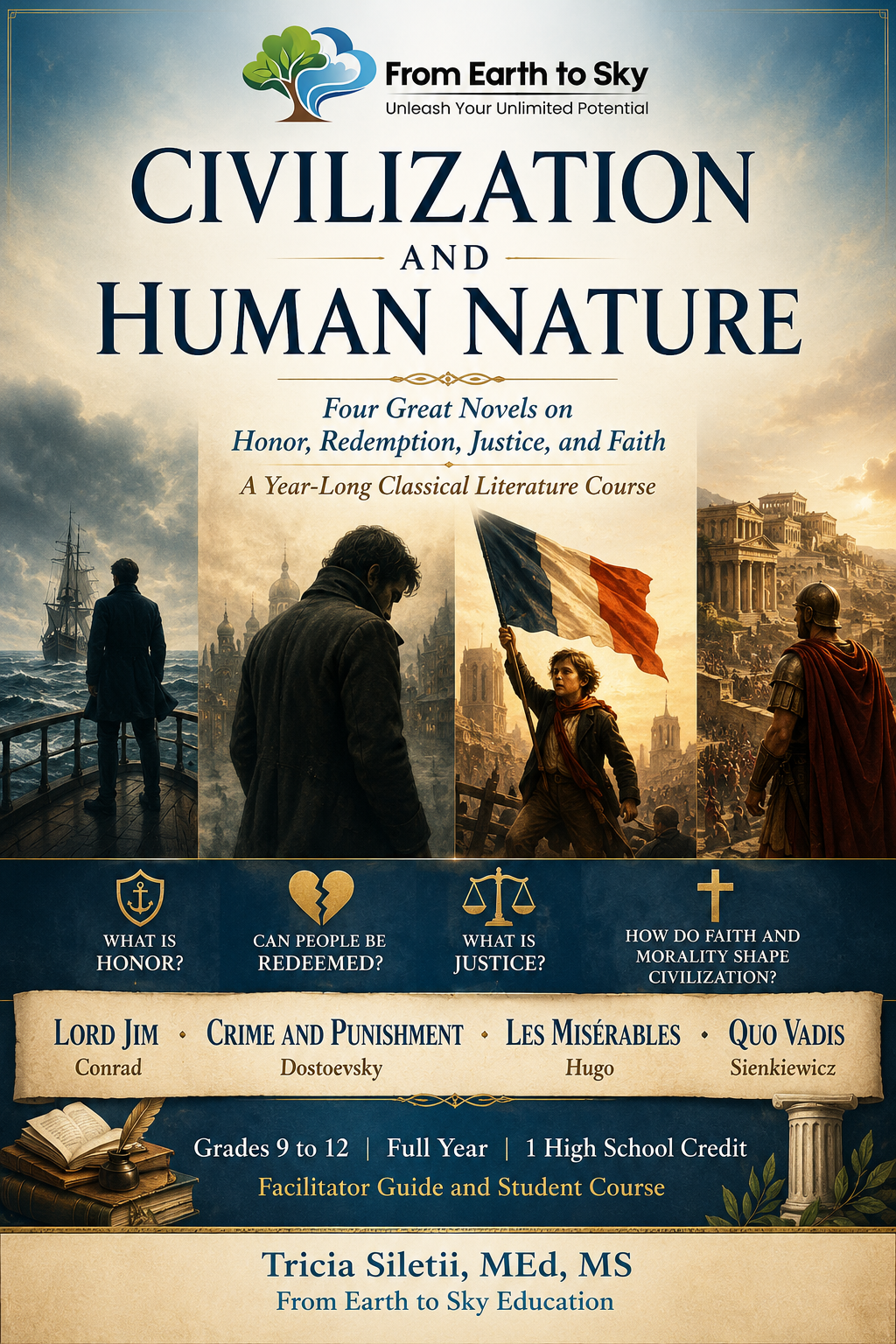
Grades 9 to 12 | Full Year | 1 High School English Credit
What makes a civilization endure? Can a person truly be redeemed? What is justice? What does it mean to live honorably?
Civilization and Human Nature is a year-long, facilitator-guided high school literature course that invites students to wrestle with some of the greatest questions ever asked through four of the most influential novels in Western literature. Rather than memorizing literary terms or completing traditional worksheets, students engage deeply with timeless stories that challenge their thinking, strengthen their character, and develop their ability to analyze complex ideas.
Students journey through:
Lord Jim by Joseph Conrad
Crime and Punishment by Fyodor Dostoevsky
Les Misérables by Victor Hugo
Quo Vadis by Henryk Sienkiewicz
Each novel centers on one of four enduring questions:
What is honor?
Can people be redeemed?
What is justice?
How do faith and morality shape civilization?
Built around the From Earth to Sky Education philosophy, this course replaces lectures and multiple-choice tests with rich discussion, reflective journaling, hands-on projects, historical exploration, philosophy, strategy games, and a culminating capstone project. Students learn to think critically, defend their ideas with textual evidence, and connect literature to history, ethics, psychology, government, and the development of civilization itself.
Throughout the 36-week course, students will:
Read and analyze four classic novels
Participate in weekly Socratic discussions
Complete engaging hands-on projects and creative activities
Explore history, philosophy, religion, and political thought
Develop analytical and argumentative writing skills
Maintain a dialectical reading journal
Create a meaningful year-end capstone project synthesizing the entire course
Unlike traditional literature curricula, this course views great books as conversations rather than assignments. Students are encouraged to question, debate, create, and reflect while building the habits of thoughtful readers and lifelong learners.
36-week complete curriculum
Grades 9 through 12
Facilitator Guide and Student Course
Full high school English credit
Classical literature approach
Integrated history, philosophy, and ethics
Socratic discussion model
Hands-on interdisciplinary projects
Portfolio-based assessment
Capstone project
Flexible for homeschool families, co-ops, microschools, and independent study
Classical homeschool programs
College-preparatory literature courses
Great Books studies
Christian and values-based education
Honors English
Humanities courses
Discussion-based learning
Independent learners
Homeschool co-ops and microschools
Literary analysis
Critical thinking
Ethical reasoning
Persuasive writing
Public speaking
Historical understanding
Philosophical inquiry
Reading comprehension
Evidence-based discussion
Independent learning
Creative problem-solving
Grades 9 to 12 | Full Year | 1 High School English Credit
What makes a civilization endure? Can a person truly be redeemed? What is justice? What does it mean to live honorably?
Civilization and Human Nature is a year-long, facilitator-guided high school literature course that invites students to wrestle with some of the greatest questions ever asked through four of the most influential novels in Western literature. Rather than memorizing literary terms or completing traditional worksheets, students engage deeply with timeless stories that challenge their thinking, strengthen their character, and develop their ability to analyze complex ideas.
Students journey through:
Lord Jim by Joseph Conrad
Crime and Punishment by Fyodor Dostoevsky
Les Misérables by Victor Hugo
Quo Vadis by Henryk Sienkiewicz
Each novel centers on one of four enduring questions:
What is honor?
Can people be redeemed?
What is justice?
How do faith and morality shape civilization?
Built around the From Earth to Sky Education philosophy, this course replaces lectures and multiple-choice tests with rich discussion, reflective journaling, hands-on projects, historical exploration, philosophy, strategy games, and a culminating capstone project. Students learn to think critically, defend their ideas with textual evidence, and connect literature to history, ethics, psychology, government, and the development of civilization itself.
Throughout the 36-week course, students will:
Read and analyze four classic novels
Participate in weekly Socratic discussions
Complete engaging hands-on projects and creative activities
Explore history, philosophy, religion, and political thought
Develop analytical and argumentative writing skills
Maintain a dialectical reading journal
Create a meaningful year-end capstone project synthesizing the entire course
Unlike traditional literature curricula, this course views great books as conversations rather than assignments. Students are encouraged to question, debate, create, and reflect while building the habits of thoughtful readers and lifelong learners.
36-week complete curriculum
Grades 9 through 12
Facilitator Guide and Student Course
Full high school English credit
Classical literature approach
Integrated history, philosophy, and ethics
Socratic discussion model
Hands-on interdisciplinary projects
Portfolio-based assessment
Capstone project
Flexible for homeschool families, co-ops, microschools, and independent study
Classical homeschool programs
College-preparatory literature courses
Great Books studies
Christian and values-based education
Honors English
Humanities courses
Discussion-based learning
Independent learners
Homeschool co-ops and microschools
Literary analysis
Critical thinking
Ethical reasoning
Persuasive writing
Public speaking
Historical understanding
Philosophical inquiry
Reading comprehension
Evidence-based discussion
Independent learning
Creative problem-solving