 Image 1 of 1
***UPDATED CURRICULUM 7/2026****
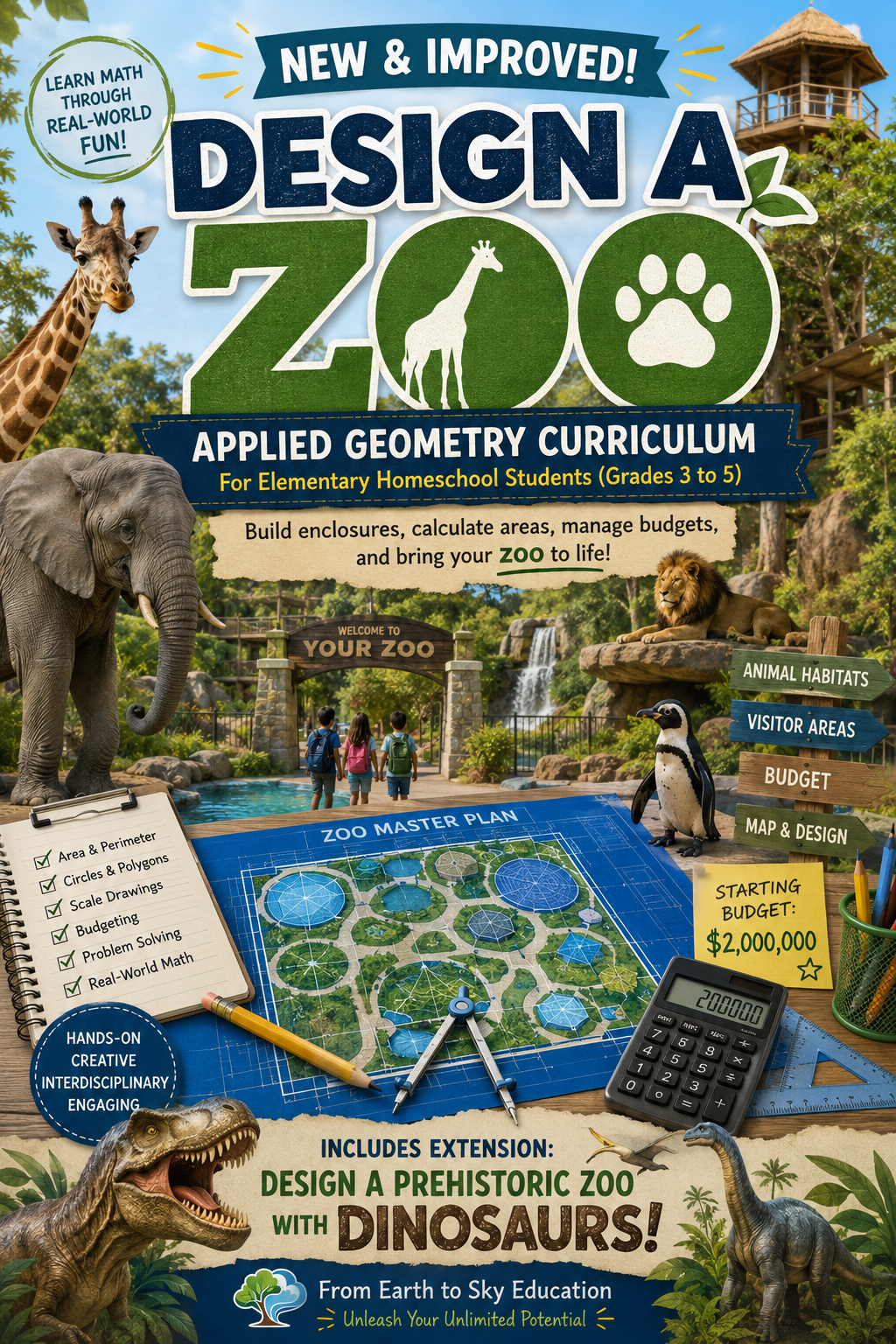
What if your child learned geometry by designing an entire zoo?
In Design a Zoo, students become zoo architects, wildlife researchers, business managers, and creative designers as they plan and build their own world-class zoo. This interdisciplinary, project-based curriculum transforms abstract math into an exciting real-world adventure where every calculation has a purpose and every decision shapes the final design.
Students begin with a $2,000,000 budget and must carefully choose animals, design habitats using geometric principles, calculate construction costs, create visitor facilities, and develop a complete scaled zoo map. Along the way, they discover that geometry is far more than formulas. It is a powerful tool used by architects, engineers, designers, and planners every day.
Unlike traditional math programs, this course integrates multiple subjects into one engaging learning experience. Students strengthen their skills in:
Geometry
Financial literacy
Animal science
Research and writing
Critical thinking
Geography
Design and engineering
Stewardship and conservation
Creative problem solving
As they design their zoo, students also research each animal and create professional information plaques that teach visitors about habitats, diets, conservation status, and fascinating facts, blending science and language arts naturally into the project.
Learning extends well beyond worksheets. Students calculate fencing, enclosure areas, visitor capacity, operating costs, ticket revenue, and long-term budgeting while creating a zoo they can proudly present to family and friends. Throughout the course they journal, participate in Socratic discussions, and choose a culminating project that best fits their interests, including building a 3D model, creating a presentation board, recording a video tour, producing a podcast, writing a research report, or designing an illustrated zoo guide.
Once students complete their modern zoo, they can take on an even bigger challenge by designing a Prehistoric Zoo featuring dinosaurs and Ice Age animals.
With a larger property, expanded budget, new engineering challenges, and extinct species to research, students apply the same geometry skills while stretching their imagination and learning about paleontology, fossils, and prehistoric ecosystems.
Calculate area, perimeter, and circumference
Apply geometry to authentic real-world problems
Design scaled layouts using graph paper
Create and manage a realistic budget
Calculate construction and operating costs
Research animals and communicate scientific information
Practice financial literacy through revenue and budgeting
Develop creativity, planning, and engineering skills
Think critically through Socratic discussion and journal prompts
Homeschool families
Project-based learners
Animal lovers
Creative thinkers
Students who learn best through hands-on experiences
Families looking for interdisciplinary curriculum
By the end of this course, your child won't simply complete a geometry unit. They'll have designed an entire zoo complete with animal habitats, visitor facilities, research displays, financial plans, and a professionally scaled map, using the same types of skills employed by architects, engineers, zoologists, and business owners.
This is math with purpose. Science with imagination. Learning that lasts.
***UPDATED CURRICULUM 7/2026****
What if your child learned geometry by designing an entire zoo?
In Design a Zoo, students become zoo architects, wildlife researchers, business managers, and creative designers as they plan and build their own world-class zoo. This interdisciplinary, project-based curriculum transforms abstract math into an exciting real-world adventure where every calculation has a purpose and every decision shapes the final design.
Students begin with a $2,000,000 budget and must carefully choose animals, design habitats using geometric principles, calculate construction costs, create visitor facilities, and develop a complete scaled zoo map. Along the way, they discover that geometry is far more than formulas. It is a powerful tool used by architects, engineers, designers, and planners every day.
Unlike traditional math programs, this course integrates multiple subjects into one engaging learning experience. Students strengthen their skills in:
Geometry
Financial literacy
Animal science
Research and writing
Critical thinking
Geography
Design and engineering
Stewardship and conservation
Creative problem solving
As they design their zoo, students also research each animal and create professional information plaques that teach visitors about habitats, diets, conservation status, and fascinating facts, blending science and language arts naturally into the project.
Learning extends well beyond worksheets. Students calculate fencing, enclosure areas, visitor capacity, operating costs, ticket revenue, and long-term budgeting while creating a zoo they can proudly present to family and friends. Throughout the course they journal, participate in Socratic discussions, and choose a culminating project that best fits their interests, including building a 3D model, creating a presentation board, recording a video tour, producing a podcast, writing a research report, or designing an illustrated zoo guide.
Once students complete their modern zoo, they can take on an even bigger challenge by designing a Prehistoric Zoo featuring dinosaurs and Ice Age animals.
With a larger property, expanded budget, new engineering challenges, and extinct species to research, students apply the same geometry skills while stretching their imagination and learning about paleontology, fossils, and prehistoric ecosystems.
Calculate area, perimeter, and circumference
Apply geometry to authentic real-world problems
Design scaled layouts using graph paper
Create and manage a realistic budget
Calculate construction and operating costs
Research animals and communicate scientific information
Practice financial literacy through revenue and budgeting
Develop creativity, planning, and engineering skills
Think critically through Socratic discussion and journal prompts
Homeschool families
Project-based learners
Animal lovers
Creative thinkers
Students who learn best through hands-on experiences
Families looking for interdisciplinary curriculum
By the end of this course, your child won't simply complete a geometry unit. They'll have designed an entire zoo complete with animal habitats, visitor facilities, research displays, financial plans, and a professionally scaled map, using the same types of skills employed by architects, engineers, zoologists, and business owners.
This is math with purpose. Science with imagination. Learning that lasts.