 Image 1 of 1
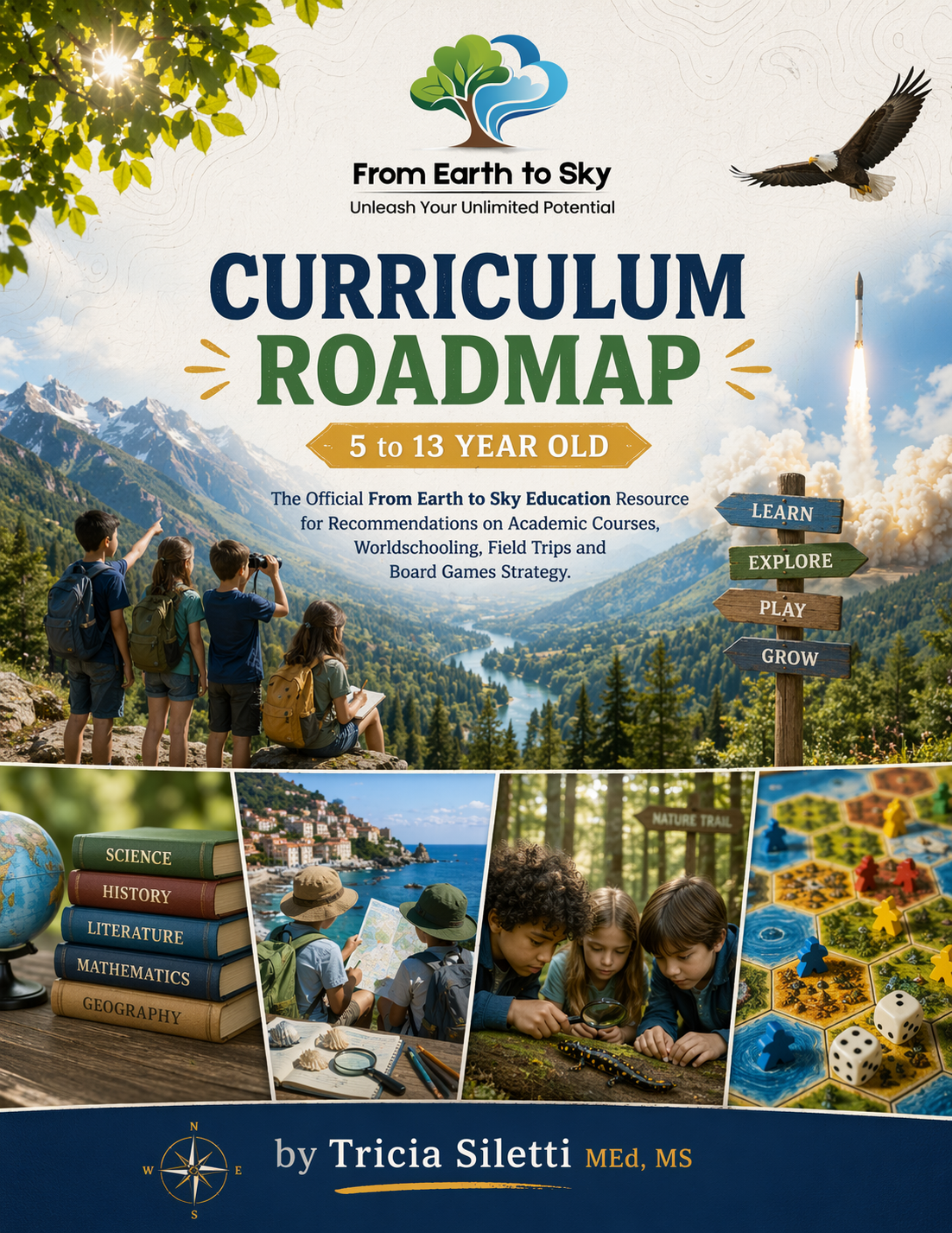
The From Earth to Sky Education Curriculum Roadmap is a comprehensive, non-traditional learning guide designed for children ages 5 to 13. It serves as a complete framework for building a rich, hands-on, and real-world education that goes far beyond textbooks and worksheets.
This roadmap organizes learning by age bands and developmental stages, guiding families through a carefully designed progression of academic subjects, life skills, and experiential learning opportunities. It integrates core disciplines such as language arts, mathematics, science, and history with practical areas like entrepreneurship, natural medicine, engineering, and the arts.
At its heart, this curriculum is built on the belief that children learn best through doing, creating, exploring, and experiencing real life. Students are not passive learners. They are investigators, builders, creators, and problem-solvers.
The roadmap also incorporates:
Worldschooling experiences to connect learning with global cultures
Field trips as essential, curriculum-based learning opportunities
Strategic board games to develop logic, critical thinking, and decision-making skills
Project-based assessments that demonstrate true understanding and capability
As outlined in the roadmap, “the world is the classroom,” and education is designed to prepare children not only academically, but also practically and confidently for real life.
This roadmap is not meant to be followed rigidly. Instead, it is a flexible guide that empowers parents to tailor education to their child’s interests, pace, and goals.
Begin by selecting the age group that best fits your child’s developmental level. The roadmap is organized to allow flexibility, recognizing that children grow and learn at different rates.
Select 3 to 5 courses that spark your child’s interest. Engagement is the foundation of meaningful learning. Courses are designed to connect across subjects, creating a cohesive learning experience.
Incorporate a balanced mix of:
Academic study
Hands-on projects
Outdoor exploration
Reading and writing
Physical activity
Use the roadmap’s built-in recommendations to enrich learning through:
Field trips
Cooking and life skills
Nature exploration
Cultural experiences
Small business or project creation
These experiences are not extras. They are central to the learning process.
Keep simple records of your child’s work:
Photos of projects
Journals and written work
Field trip logs
Portfolios
This documentation becomes a powerful record of growth and can later translate into transcripts and academic records.
Incorporate recommended board games to reinforce skills like:
Critical thinking
Strategy
Math and probability
Communication
Learning happens naturally through play when used intentionally.
Each course builds on the next, guiding students from foundational skills in early years to advanced thinking, independence, and real-world application by middle school.
By following this roadmap, families are not just completing a curriculum. They are cultivating a child who:
Thinks critically
Works independently
Communicates clearly
Solves real problems
Engages confidently with the world
This is education designed not just for school, but for life.
The From Earth to Sky Education Curriculum Roadmap is a comprehensive, non-traditional learning guide designed for children ages 5 to 13. It serves as a complete framework for building a rich, hands-on, and real-world education that goes far beyond textbooks and worksheets.
This roadmap organizes learning by age bands and developmental stages, guiding families through a carefully designed progression of academic subjects, life skills, and experiential learning opportunities. It integrates core disciplines such as language arts, mathematics, science, and history with practical areas like entrepreneurship, natural medicine, engineering, and the arts.
At its heart, this curriculum is built on the belief that children learn best through doing, creating, exploring, and experiencing real life. Students are not passive learners. They are investigators, builders, creators, and problem-solvers.
The roadmap also incorporates:
Worldschooling experiences to connect learning with global cultures
Field trips as essential, curriculum-based learning opportunities
Strategic board games to develop logic, critical thinking, and decision-making skills
Project-based assessments that demonstrate true understanding and capability
As outlined in the roadmap, “the world is the classroom,” and education is designed to prepare children not only academically, but also practically and confidently for real life.
This roadmap is not meant to be followed rigidly. Instead, it is a flexible guide that empowers parents to tailor education to their child’s interests, pace, and goals.
Begin by selecting the age group that best fits your child’s developmental level. The roadmap is organized to allow flexibility, recognizing that children grow and learn at different rates.
Select 3 to 5 courses that spark your child’s interest. Engagement is the foundation of meaningful learning. Courses are designed to connect across subjects, creating a cohesive learning experience.
Incorporate a balanced mix of:
Academic study
Hands-on projects
Outdoor exploration
Reading and writing
Physical activity
Use the roadmap’s built-in recommendations to enrich learning through:
Field trips
Cooking and life skills
Nature exploration
Cultural experiences
Small business or project creation
These experiences are not extras. They are central to the learning process.
Keep simple records of your child’s work:
Photos of projects
Journals and written work
Field trip logs
Portfolios
This documentation becomes a powerful record of growth and can later translate into transcripts and academic records.
Incorporate recommended board games to reinforce skills like:
Critical thinking
Strategy
Math and probability
Communication
Learning happens naturally through play when used intentionally.
Each course builds on the next, guiding students from foundational skills in early years to advanced thinking, independence, and real-world application by middle school.
By following this roadmap, families are not just completing a curriculum. They are cultivating a child who:
Thinks critically
Works independently
Communicates clearly
Solves real problems
Engages confidently with the world
This is education designed not just for school, but for life.