 Image 1 of 1
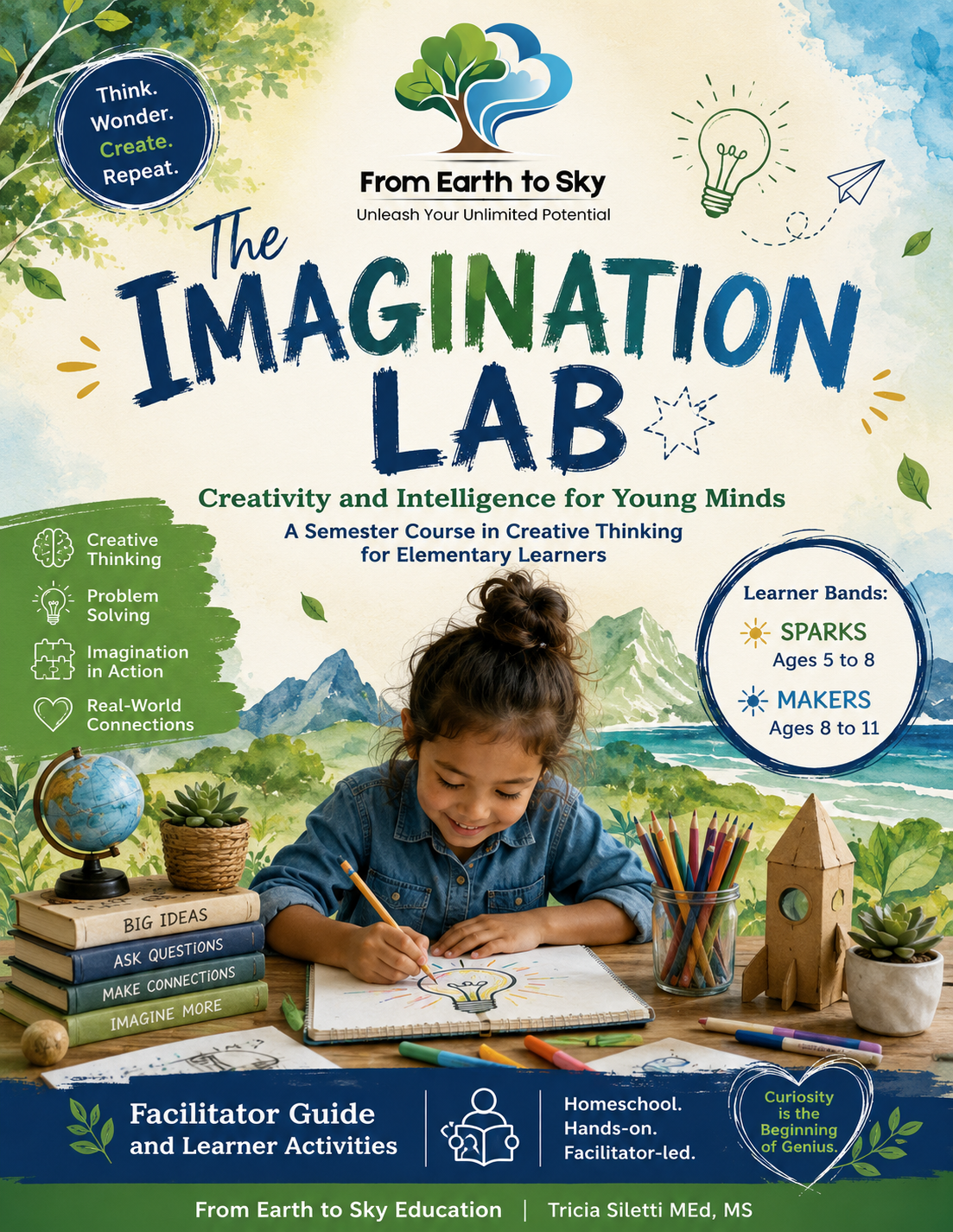
A Semester Course in Creative Thinking for Elementary Learners
Unlock your child's creative potential with a hands-on homeschool curriculum designed to develop imagination, critical thinking, and real-world problem solving.
The Imagination Lab is an engaging 18 week homeschool curriculum that helps children strengthen one of the most important skills for lifelong success: creative thinking. Through playful challenges, invention activities, storytelling, design thinking, Socratic discussion, and project-based learning, learners discover that creativity is not a talent reserved for artists. It is a skill that can be practiced, nurtured, and applied in every area of life.
Built for homeschool families, this facilitator-guided course uses decades of creativity research, including the work of E. Paul Torrance, J. P. Guilford, Edward de Bono, Howard Gardner, and Graham Wallas, while presenting every lesson in a simple, hands-on format that children love.
Designed with two learner levels, Sparks (ages 5 to 8) and Makers (ages 8 to 11), the curriculum allows siblings to learn together while completing activities at their own developmental level.
Throughout six engaging units, learners will:
Build creative confidence through open-ended challenges.
Practice divergent and lateral thinking.
Develop flexibility, originality, fluency, and elaboration.
Invent new products using SCAMPER design thinking.
Complete storytelling and imagination activities.
Strengthen communication through Socratic discussion.
Discover multiple intelligences and personal strengths.
Create a portfolio that showcases their creative growth.
Complete a culminating invention or creative project.
Rather than relying on worksheets and tests, The Imagination Lab emphasizes authentic learning through conversation, journaling, portfolios, reflection, and meaningful projects. It encourages learners to ask better questions, embrace curiosity, and see mistakes as opportunities for innovation.
The course also weaves Hawaiian values including aloha, kuleana, mālama, ho'omau, moʻolelo, ʻohana, pono, and naʻauao throughout each unit, helping children develop character alongside creativity.
Perfect for homeschool families who want to move beyond memorization, The Imagination Lab equips children with the thinking skills needed for entrepreneurship, STEM, engineering, writing, leadership, and lifelong learning.
18 week facilitator-guided curriculum
Complete facilitator guide
Learner activities for two age bands
Socratic discussion questions
Creativity journal prompts
Portfolio assessments
Hands-on invention challenges
Storytelling and imagination activities
Printable creativity worksheets
Culminating creative project
Book recommendations
Field trip and worldschooling ideas
Standards alignment documentation
Homeschool families
Classical homeschool programs
Charlotte Mason-inspired learning
Unit studies
Gifted and twice-exceptional learners
Project-based learning
Microschools and learning pods
Co-ops
Family-style learning with multiple ages
A Semester Course in Creative Thinking for Elementary Learners
Unlock your child's creative potential with a hands-on homeschool curriculum designed to develop imagination, critical thinking, and real-world problem solving.
The Imagination Lab is an engaging 18 week homeschool curriculum that helps children strengthen one of the most important skills for lifelong success: creative thinking. Through playful challenges, invention activities, storytelling, design thinking, Socratic discussion, and project-based learning, learners discover that creativity is not a talent reserved for artists. It is a skill that can be practiced, nurtured, and applied in every area of life.
Built for homeschool families, this facilitator-guided course uses decades of creativity research, including the work of E. Paul Torrance, J. P. Guilford, Edward de Bono, Howard Gardner, and Graham Wallas, while presenting every lesson in a simple, hands-on format that children love.
Designed with two learner levels, Sparks (ages 5 to 8) and Makers (ages 8 to 11), the curriculum allows siblings to learn together while completing activities at their own developmental level.
Throughout six engaging units, learners will:
Build creative confidence through open-ended challenges.
Practice divergent and lateral thinking.
Develop flexibility, originality, fluency, and elaboration.
Invent new products using SCAMPER design thinking.
Complete storytelling and imagination activities.
Strengthen communication through Socratic discussion.
Discover multiple intelligences and personal strengths.
Create a portfolio that showcases their creative growth.
Complete a culminating invention or creative project.
Rather than relying on worksheets and tests, The Imagination Lab emphasizes authentic learning through conversation, journaling, portfolios, reflection, and meaningful projects. It encourages learners to ask better questions, embrace curiosity, and see mistakes as opportunities for innovation.
The course also weaves Hawaiian values including aloha, kuleana, mālama, ho'omau, moʻolelo, ʻohana, pono, and naʻauao throughout each unit, helping children develop character alongside creativity.
Perfect for homeschool families who want to move beyond memorization, The Imagination Lab equips children with the thinking skills needed for entrepreneurship, STEM, engineering, writing, leadership, and lifelong learning.
18 week facilitator-guided curriculum
Complete facilitator guide
Learner activities for two age bands
Socratic discussion questions
Creativity journal prompts
Portfolio assessments
Hands-on invention challenges
Storytelling and imagination activities
Printable creativity worksheets
Culminating creative project
Book recommendations
Field trip and worldschooling ideas
Standards alignment documentation
Homeschool families
Classical homeschool programs
Charlotte Mason-inspired learning
Unit studies
Gifted and twice-exceptional learners
Project-based learning
Microschools and learning pods
Co-ops
Family-style learning with multiple ages