 Image 1 of 1
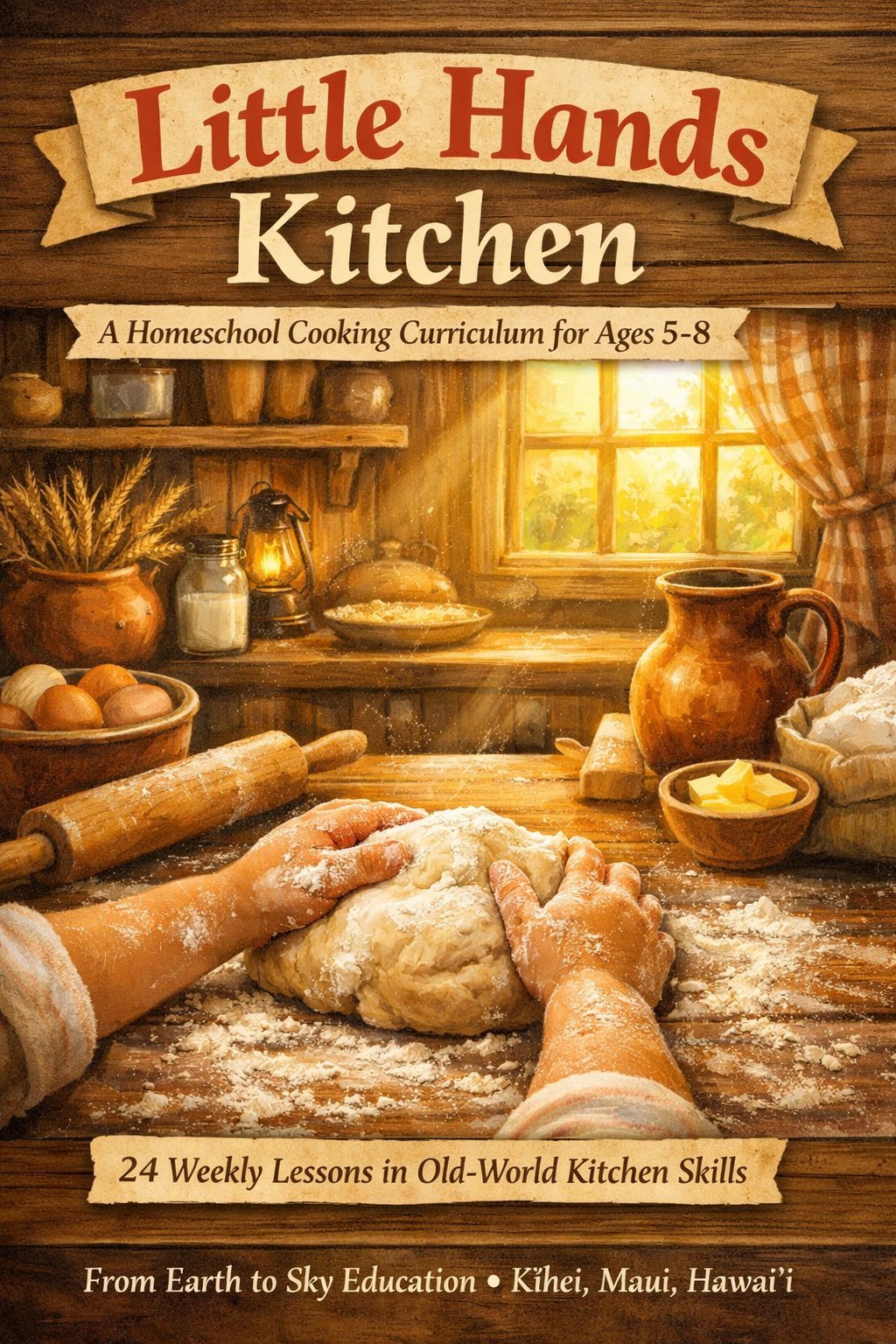
24 Weekly Lessons in Old-World Kitchen Skills
What if your child could learn fractions while measuring flour? Understand chemistry while watching yeast bubble? Explore world history while kneading bread dough passed down through generations?
Little Hands Kitchen is more than a cooking curriculum. It's a complete, multi-subject educational experience disguised as the most delicious school day your child has ever had.
24 complete weekly lessons organized into 8 thematic units, each designed for 60-90 minute sessions. Every lesson includes:
Step-by-step recipes with clear instructions
Specific learning objectives
Hands-on tasks appropriate for ages 5-8
Discussion questions that spark curiosity
Cross-curricular connections to math, science, history, geography, reading, and more
Safety notes for each activity
Recipe continuations showing what to make next
Here's what a single lesson looks like in action:
What They're Making: Fresh butter from cream in a mason jar
What They're Actually Learning:
SubjectConnectionSciencePhysical transformation, emulsion breaking, fat molecules clumping togetherMathMeasuring cups, timing each stage, comparing starting vs. ending amountsHistoryHow families preserved food before refrigeration, researching butter churnsPhysical EducationRhythmic shaking builds persistence and coordinationLanguage ArtsNew vocabulary: buttermilk, emulsion, churn
Your child finishes the lesson with butter they made themselves, a deeper understanding of where food comes from, and knowledge that spans five subject areas.
And they had fun doing it.
Unit 1: Dairy Fundamentals Homemade Butter • Fresh Ricotta Cheese
Unit 2: Yeast Breads Simple Yeast Bread • Pizza Dough
Unit 3: Sourdough Adventures Sourdough Starter & Crackers • Breadsticks • Focaccia • Bagels
Unit 4: Flat Breads & Pasta Hand-Rolled Pasta • Flour Tortillas • Cheese Crackers
Unit 5: Hearty Meals Vegetable Soup • Meatloaf & Scalloped Potatoes • Macaroni & Cheese • Homemade Sausages
Unit 6: Preserving & Condiments Homemade Ketchup • Mayonnaise • Chocolate Syrup • Applesauce • Berry Jam • Refrigerator Pickles
Unit 7: Fermentation Sauerkraut • Kombucha
Unit 8: Sweet Treats Marshmallows (made with real marshmallow root!) • Lilikoi-Date Ice Cream • Whoopie Pies
Making Sourdough Starter (Week 5) Your child captures wild yeast from the air, feeds it daily like a pet, and learns responsibility while exploring microbiology. They'll discover that Gold Rush miners carried starters around their necks to keep them warm. That's science, history, and life skills in a single jar of bubbling flour and water.
Hand-Rolled Pasta (Week 9) Children create a flour "volcano," crack eggs into the crater, and slowly incorporate the flour. They practice fractions (¼ inch for fettuccine, ⅛ inch for linguine), learn about gluten development, and discover that Marco Polo may have encountered noodles in China. One recipe. Math, science, geography, and fine motor skills.
Homemade Ketchup (Week 16) Before cooking, your child reads the ingredient label on store-bought ketchup. High fructose corn syrup. Sodium benzoate. Natural flavors. Then they make their own with just six ingredients: tomatoes, vinegar, honey, and spices. This is consumer education. Critical thinking. And a ketchup that actually tastes like tomatoes.
Vegetable Soup (Week 12) This lesson teaches that there's no single "right" recipe for soup. Children learn knife safety, practice "mise en place," explore how different cultures make soup based on what grows in their region, and discover the vocabulary of cooking: sauté, simmer, dice, mince. The lesson includes Italian Minestrone, French Country, Mexican-Style, and Asian-Inspired variations.
I spent years teaching my oldest child to be more self-sufficient in the kitchen. What started as cooking lessons became something deeper: learning to read ingredient labels, questioning what's really in our food, and understanding that our great-grandparents knew how to make everything from scratch.
The foods on grocery store shelves today are filled with preservatives, artificial ingredients, and chemicals that were never part of the human diet until recent decades. Most families have lost the simple skills to make real food from real ingredients.
This curriculum changes that.
Every recipe uses simple ingredients you can pronounce. Every lesson teaches children not just how to cook, but how to think critically about the food they put into their bodies.
When your child makes their own bread, they realize it only needs flour, water, yeast, and salt.
When they make their own mayonnaise, they discover it's just eggs, oil, lemon, and mustard.
When they ferment their own sauerkraut, they learn that humans preserved food for thousands of years without refrigeration or chemical additives.
These lessons plant seeds of wisdom that will grow throughout their lives.
"My 6-year-old now reads ingredient labels at the grocery store and asks why there are so many things she can't pronounce. That's worth more than any worksheet."
"We replaced our entire language arts block on Fridays with Little Hands Kitchen. The vocabulary, the reading, the sequencing, the discussion... it covers everything and my kids BEG for cooking day."
"My son struggled with fractions until we started measuring ingredients. Now he gets it. Turns out he just needed to see ½ cup in real life."
✓ 24 Complete Lesson Plans covering dairy, breads, sourdough, pasta, meals, condiments, fermentation, and sweets
✓ Full Recipes with ingredients, equipment lists, and step-by-step instructions
✓ Learning Objectives for every lesson
✓ Hands-On Tasks appropriate for ages 5-8
✓ Discussion Questions that encourage curiosity and critical thinking
✓ Cross-Curricular Connections linking each recipe to math, science, history, geography, reading, art, and health
✓ Safety Notes for every activity
✓ Recipe Continuations showing how basic skills lead to advanced techniques
✓ Professional formatting ready to print or use digitally
Homeschool families looking for hands-on, multi-subject learning
Parents who want to teach practical life skills
Families interested in real food and simple ingredients
Co-ops and Homeschool Hui groups seeking engaging Friday activities
Anyone who believes children learn best by doing
24 Weekly Lessons in Old-World Kitchen Skills
What if your child could learn fractions while measuring flour? Understand chemistry while watching yeast bubble? Explore world history while kneading bread dough passed down through generations?
Little Hands Kitchen is more than a cooking curriculum. It's a complete, multi-subject educational experience disguised as the most delicious school day your child has ever had.
24 complete weekly lessons organized into 8 thematic units, each designed for 60-90 minute sessions. Every lesson includes:
Step-by-step recipes with clear instructions
Specific learning objectives
Hands-on tasks appropriate for ages 5-8
Discussion questions that spark curiosity
Cross-curricular connections to math, science, history, geography, reading, and more
Safety notes for each activity
Recipe continuations showing what to make next
Here's what a single lesson looks like in action:
What They're Making: Fresh butter from cream in a mason jar
What They're Actually Learning:
SubjectConnectionSciencePhysical transformation, emulsion breaking, fat molecules clumping togetherMathMeasuring cups, timing each stage, comparing starting vs. ending amountsHistoryHow families preserved food before refrigeration, researching butter churnsPhysical EducationRhythmic shaking builds persistence and coordinationLanguage ArtsNew vocabulary: buttermilk, emulsion, churn
Your child finishes the lesson with butter they made themselves, a deeper understanding of where food comes from, and knowledge that spans five subject areas.
And they had fun doing it.
Unit 1: Dairy Fundamentals Homemade Butter • Fresh Ricotta Cheese
Unit 2: Yeast Breads Simple Yeast Bread • Pizza Dough
Unit 3: Sourdough Adventures Sourdough Starter & Crackers • Breadsticks • Focaccia • Bagels
Unit 4: Flat Breads & Pasta Hand-Rolled Pasta • Flour Tortillas • Cheese Crackers
Unit 5: Hearty Meals Vegetable Soup • Meatloaf & Scalloped Potatoes • Macaroni & Cheese • Homemade Sausages
Unit 6: Preserving & Condiments Homemade Ketchup • Mayonnaise • Chocolate Syrup • Applesauce • Berry Jam • Refrigerator Pickles
Unit 7: Fermentation Sauerkraut • Kombucha
Unit 8: Sweet Treats Marshmallows (made with real marshmallow root!) • Lilikoi-Date Ice Cream • Whoopie Pies
Making Sourdough Starter (Week 5) Your child captures wild yeast from the air, feeds it daily like a pet, and learns responsibility while exploring microbiology. They'll discover that Gold Rush miners carried starters around their necks to keep them warm. That's science, history, and life skills in a single jar of bubbling flour and water.
Hand-Rolled Pasta (Week 9) Children create a flour "volcano," crack eggs into the crater, and slowly incorporate the flour. They practice fractions (¼ inch for fettuccine, ⅛ inch for linguine), learn about gluten development, and discover that Marco Polo may have encountered noodles in China. One recipe. Math, science, geography, and fine motor skills.
Homemade Ketchup (Week 16) Before cooking, your child reads the ingredient label on store-bought ketchup. High fructose corn syrup. Sodium benzoate. Natural flavors. Then they make their own with just six ingredients: tomatoes, vinegar, honey, and spices. This is consumer education. Critical thinking. And a ketchup that actually tastes like tomatoes.
Vegetable Soup (Week 12) This lesson teaches that there's no single "right" recipe for soup. Children learn knife safety, practice "mise en place," explore how different cultures make soup based on what grows in their region, and discover the vocabulary of cooking: sauté, simmer, dice, mince. The lesson includes Italian Minestrone, French Country, Mexican-Style, and Asian-Inspired variations.
I spent years teaching my oldest child to be more self-sufficient in the kitchen. What started as cooking lessons became something deeper: learning to read ingredient labels, questioning what's really in our food, and understanding that our great-grandparents knew how to make everything from scratch.
The foods on grocery store shelves today are filled with preservatives, artificial ingredients, and chemicals that were never part of the human diet until recent decades. Most families have lost the simple skills to make real food from real ingredients.
This curriculum changes that.
Every recipe uses simple ingredients you can pronounce. Every lesson teaches children not just how to cook, but how to think critically about the food they put into their bodies.
When your child makes their own bread, they realize it only needs flour, water, yeast, and salt.
When they make their own mayonnaise, they discover it's just eggs, oil, lemon, and mustard.
When they ferment their own sauerkraut, they learn that humans preserved food for thousands of years without refrigeration or chemical additives.
These lessons plant seeds of wisdom that will grow throughout their lives.
"My 6-year-old now reads ingredient labels at the grocery store and asks why there are so many things she can't pronounce. That's worth more than any worksheet."
"We replaced our entire language arts block on Fridays with Little Hands Kitchen. The vocabulary, the reading, the sequencing, the discussion... it covers everything and my kids BEG for cooking day."
"My son struggled with fractions until we started measuring ingredients. Now he gets it. Turns out he just needed to see ½ cup in real life."
✓ 24 Complete Lesson Plans covering dairy, breads, sourdough, pasta, meals, condiments, fermentation, and sweets
✓ Full Recipes with ingredients, equipment lists, and step-by-step instructions
✓ Learning Objectives for every lesson
✓ Hands-On Tasks appropriate for ages 5-8
✓ Discussion Questions that encourage curiosity and critical thinking
✓ Cross-Curricular Connections linking each recipe to math, science, history, geography, reading, art, and health
✓ Safety Notes for every activity
✓ Recipe Continuations showing how basic skills lead to advanced techniques
✓ Professional formatting ready to print or use digitally
Homeschool families looking for hands-on, multi-subject learning
Parents who want to teach practical life skills
Families interested in real food and simple ingredients
Co-ops and Homeschool Hui groups seeking engaging Friday activities
Anyone who believes children learn best by doing