 Image 1 of 1
By Tricia Siletti, MEd, MS
From Earth to Sky Education
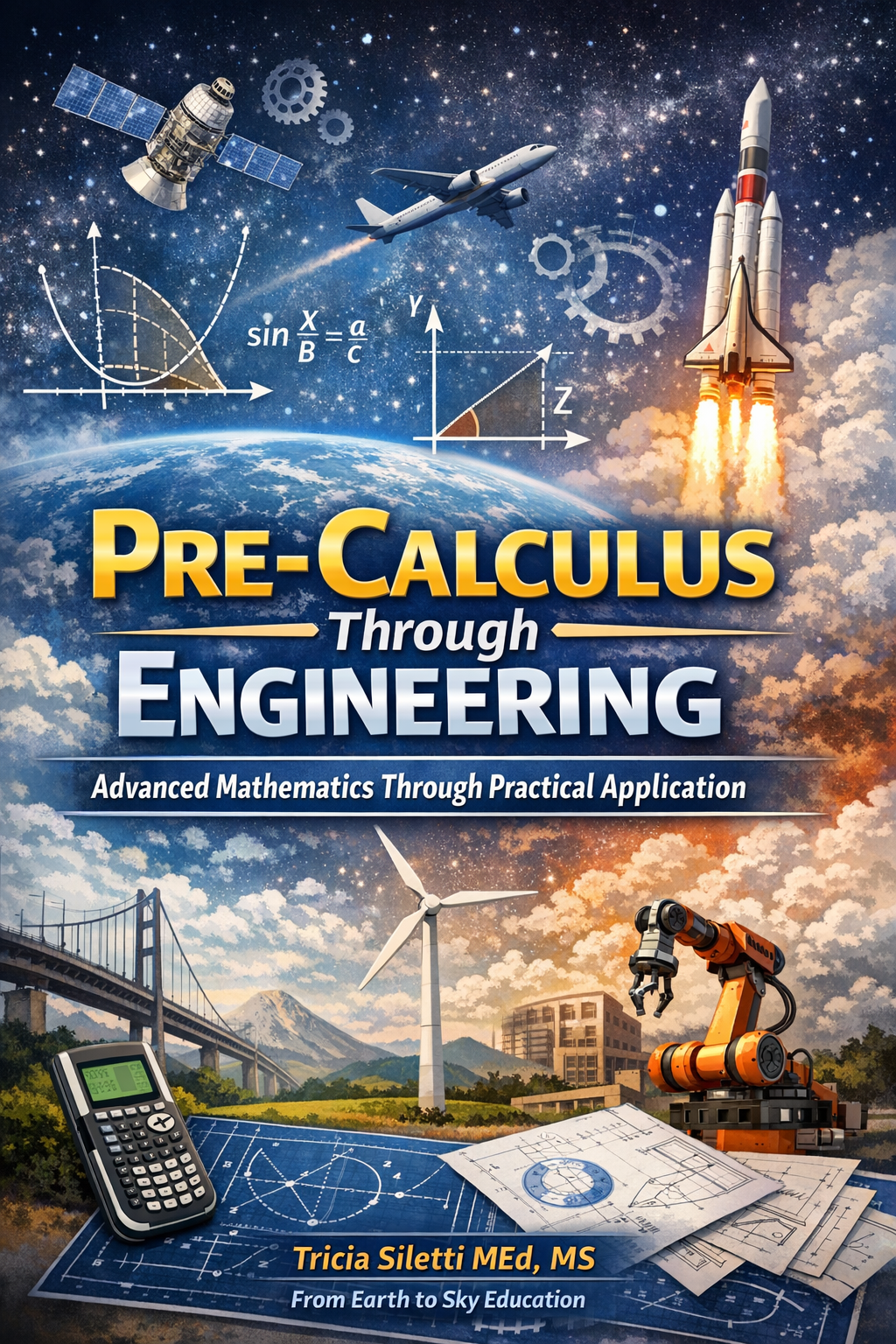
What if students didn’t just learn pre-calculus… but used it to design bridges, analyze rocket trajectories, and build real engineering systems?
Pre-Calculus Through Engineering transforms advanced mathematics into a hands-on, real-world experience where every concept is applied with purpose.
This is not a traditional textbook course.
This is mathematics brought to life through engineering.
Instead of memorizing formulas in isolation, students:
Apply functions to design load-bearing bridges
Use trigonometry to model rocket trajectories
Analyze sinusoidal waves through circuit design
Model exponential systems in water distribution engineering
Use vectors and parametrics in gear system design
Integrate all concepts into a real-world capstone engineering project
Every unit begins with a real engineering challenge, then builds the exact math needed to solve it.
Full Year Curriculum (36 Weeks)
High School Level (Ages 15–18)
1 Full Math Credit (Pre-Calculus / Advanced Math)
Honors-Level Rigor with Applied STEM Focus
Students complete 6 major engineering units:
Structural Engineering: Bridge Design
Aerospace Engineering: Rocket Trajectory
Electrical Engineering: Circuit Design
Civil Engineering: Water Systems
Mechanical Engineering: Gear Systems
Capstone: Renewable Energy System Design
Each unit follows a powerful learning cycle:
Engineering Challenge
Concept Development
Guided Practice
Design & Build
Testing & Analysis
Documentation & Reflection
This course uses a project-based, portfolio-driven approach:
No busywork
No meaningless worksheets
No traditional tests
Instead, students demonstrate mastery by:
Building real models
Creating mathematical systems
Writing engineering reports
Analyzing real data
Reflecting on their thinking
By the end of the course, students have a professional-level portfolio showcasing both mathematical and engineering competency.
You do not need to be a math expert.
This course is designed so that the parent serves as a facilitator, not a lecturer.
Clear explanations of all math concepts
Guided discussion prompts
Step-by-step project structure
Built-in assessment rubrics
It empowers you to guide advanced learning with confidence.
Functions (polynomial, exponential, logarithmic, trigonometric)
Analytic geometry, vectors, and parametrics
Polar coordinates and conic sections
Sequences, series, and limits
Real-world mathematical modeling
Engineering design thinking
Most importantly, students will understand:
Why math matters.
How math works in the real world.
And how to use it to solve meaningful problems.
Graphing calculator (TI-84 recommended)
Access to Desmos (free)
Basic building materials (balsa wood, cardboard, etc.)
Notebook or engineering journal
Optional: Tinkercad or simple modeling tools
Homeschool high school students
STEM-focused learners
Hands-on, project-based learners
Students preparing for engineering, science, or technical careers
Families who want rigorous academics without traditional schooling methods
Most students finish math courses asking:
"When will I ever use this?"
Students in this course finish knowing:
“I already have.”
Give them the ability to:
Think critically
Build confidently
Solve real problems
Create with purpose
By Tricia Siletti, MEd, MS
From Earth to Sky Education
What if students didn’t just learn pre-calculus… but used it to design bridges, analyze rocket trajectories, and build real engineering systems?
Pre-Calculus Through Engineering transforms advanced mathematics into a hands-on, real-world experience where every concept is applied with purpose.
This is not a traditional textbook course.
This is mathematics brought to life through engineering.
Instead of memorizing formulas in isolation, students:
Apply functions to design load-bearing bridges
Use trigonometry to model rocket trajectories
Analyze sinusoidal waves through circuit design
Model exponential systems in water distribution engineering
Use vectors and parametrics in gear system design
Integrate all concepts into a real-world capstone engineering project
Every unit begins with a real engineering challenge, then builds the exact math needed to solve it.
Full Year Curriculum (36 Weeks)
High School Level (Ages 15–18)
1 Full Math Credit (Pre-Calculus / Advanced Math)
Honors-Level Rigor with Applied STEM Focus
Students complete 6 major engineering units:
Structural Engineering: Bridge Design
Aerospace Engineering: Rocket Trajectory
Electrical Engineering: Circuit Design
Civil Engineering: Water Systems
Mechanical Engineering: Gear Systems
Capstone: Renewable Energy System Design
Each unit follows a powerful learning cycle:
Engineering Challenge
Concept Development
Guided Practice
Design & Build
Testing & Analysis
Documentation & Reflection
This course uses a project-based, portfolio-driven approach:
No busywork
No meaningless worksheets
No traditional tests
Instead, students demonstrate mastery by:
Building real models
Creating mathematical systems
Writing engineering reports
Analyzing real data
Reflecting on their thinking
By the end of the course, students have a professional-level portfolio showcasing both mathematical and engineering competency.
You do not need to be a math expert.
This course is designed so that the parent serves as a facilitator, not a lecturer.
Clear explanations of all math concepts
Guided discussion prompts
Step-by-step project structure
Built-in assessment rubrics
It empowers you to guide advanced learning with confidence.
Functions (polynomial, exponential, logarithmic, trigonometric)
Analytic geometry, vectors, and parametrics
Polar coordinates and conic sections
Sequences, series, and limits
Real-world mathematical modeling
Engineering design thinking
Most importantly, students will understand:
Why math matters.
How math works in the real world.
And how to use it to solve meaningful problems.
Graphing calculator (TI-84 recommended)
Access to Desmos (free)
Basic building materials (balsa wood, cardboard, etc.)
Notebook or engineering journal
Optional: Tinkercad or simple modeling tools
Homeschool high school students
STEM-focused learners
Hands-on, project-based learners
Students preparing for engineering, science, or technical careers
Families who want rigorous academics without traditional schooling methods
Most students finish math courses asking:
"When will I ever use this?"
Students in this course finish knowing:
“I already have.”
Give them the ability to:
Think critically
Build confidently
Solve real problems
Create with purpose