 Image 1 of 1
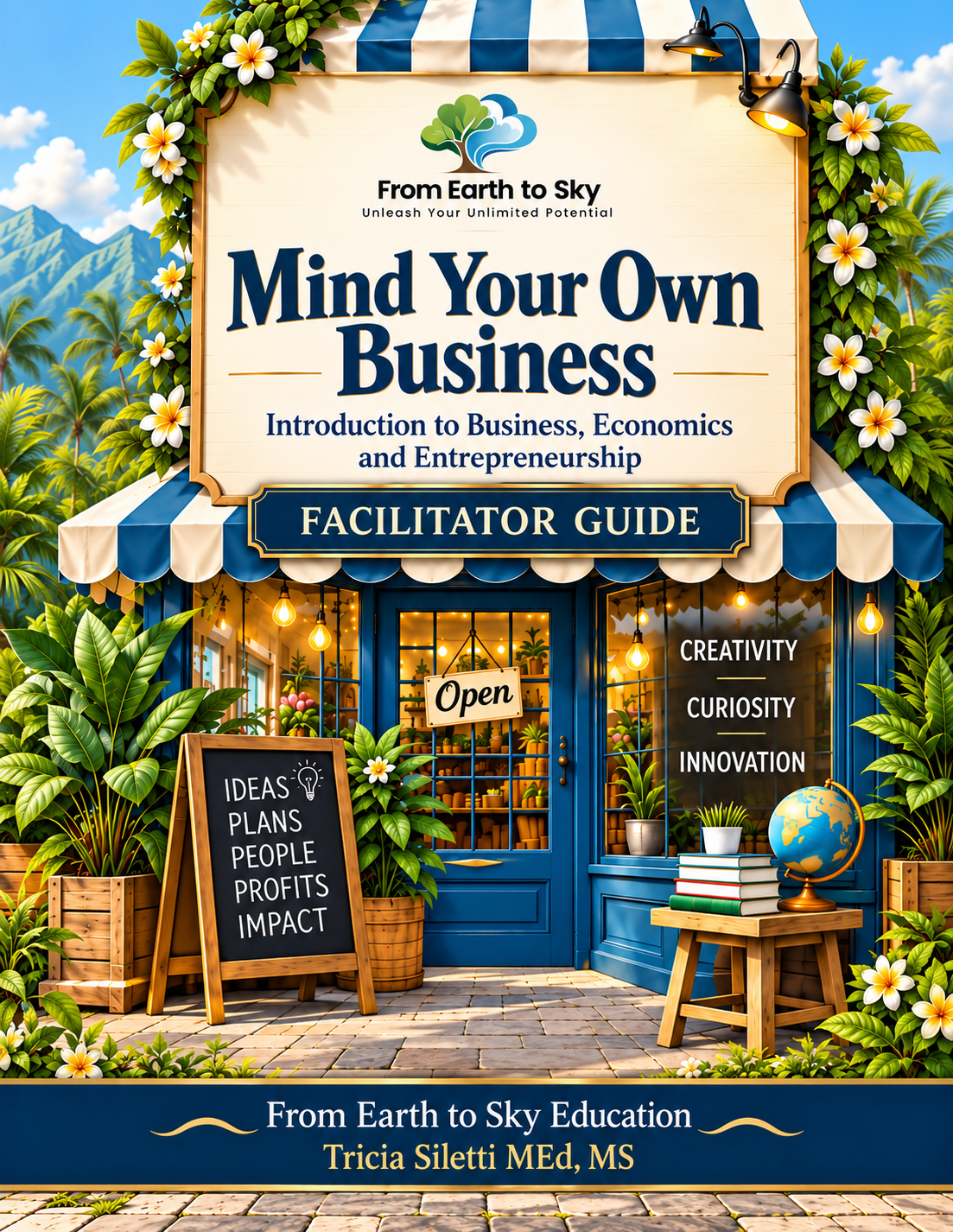
Mind Your Own Business: High School Business, Economics & Entrepreneurship Curriculum
$40.00
18-Week High School Business & Economics Course | Grades 9–12 | 0.5 Credit | Hands-On Entrepreneurship | Homeschool & Co-op
Download FREE Student Workbook to accompany this guide.
What if your high school student could learn economics, understand how businesses operate, and develop their own entrepreneurial ideas without spending a semester memorizing vocabulary and taking tests?
Mind Your Own Business: Introduction to Business, Economics and Entrepreneurship is an engaging, student-led, 18-week high school curriculum that brings the world of business to life through real-world investigations, hands-on projects, creative problem-solving, financial literacy, and entrepreneurship.
Designed for homeschool families, high school co-ops, alternative education programs, and independent learners, this one-semester course encourages students to think like entrepreneurs, understand economic principles, and explore what it really takes to build a successful business.
Instead of simply reading about entrepreneurship, students develop their own business concept throughout the semester, investigate real businesses, analyze financial decisions, explore markets, and finish with a Founder's Showcase.
No business or economics teaching experience is required!
This is not your typical textbook-based high school economics class.
Students become active participants in their learning through:
Real-World Entrepreneurship: Develop a business concept from identifying a customer need to designing a business model.
Hands-On Learning: Explore economics through simulations, trading games, building projects, product prototypes, and experiments.
Critical Thinking: Analyze business decisions, evaluate economic trade-offs, and defend recommendations using evidence.
Financial Literacy: Investigate revenue, expenses, profit, pricing, budgeting, money, inflation, and business finances.
Socratic Discussion: Participate in weekly Boardroom Conferences that encourage independent thinking rather than memorization.
Creative Problem-Solving: Explore marketing, competition, customer needs, innovation, and business ethics.
Project-Based Assessment: Demonstrate understanding through six major projects instead of traditional tests.
Students also meet Marv Fenwick, a lovable serial entrepreneur whose questionable business decisions create entertaining opportunities to analyze mistakes, evaluate evidence, and develop better solutions.
This comprehensive Facilitator Guide provides the tools needed to support students throughout the entire semester.
Includes:
18 weeks of structured business, economics, and entrepreneurship lessons
Six thematic instructional units
Weekly facilitator instructions and background information
Socratic discussion questions for weekly Boardroom Conferences
Complete answer keys and model responses
Hands-on activity guidance and materials lists
Six Signature Piece assessment rubrics
Guidance for grading and high school transcript documentation
Bloom's Taxonomy and Multiple Intelligences resources
Suggested educational games, online resources, and field trips
Additional learning opportunities and standards alignment
Student Workbook: The companion Student Workbook is available as a FREE download at easyhomeschool.org.
Unit 1: Open for Business (Weeks 1–3)
Discover what businesses do, why customers purchase goods and services, forms of business ownership, economic sectors, and the role of small businesses in communities. Students interview a real business owner and create a Business Profile.
Unit 2: The Rules of the Game (Weeks 4–6)
Investigate scarcity, opportunity cost, supply and demand, competition, market structures, and free enterprise. Hands-on trading activities and economic simulations help students discover how markets operate.
Unit 3: The Big Picture (Weeks 7–9)
Explore the broader economy, including GDP, business cycles, employment, banking, inflation, international trade, exchange rates, and global supply chains.
Unit 4: Inside the Machine (Weeks 10–12)
Examine how businesses function through management, organizational decisions, ethical marketing, branding, accounting, pricing, and financial analysis.
Unit 5: The Founder's Mindset (Weeks 13–15)
Develop entrepreneurial thinking by identifying problems worth solving, researching customers, testing business ideas, and creating prototypes.
Unit 6: Launch Pad (Weeks 16–18)
Bring everything together through business planning, financial decisions, legal and ethical considerations, and the final Founder's Showcase.
Recommended Grades: 9–12
Course Length: 18 Weeks / One Semester
Suggested Credit: 0.5 High School Credit
Subjects: Business, Economics, Entrepreneurship
Learning Format: Student-Led, Project-Based, Hands-On
Assessment: Projects, portfolios, discussions, and rubrics instead of traditional tests
Students generally complete workbook activities four days each week, while facilitators provide weekly support through brief review, assessment, and a 20-minute Boardroom Conference.
This curriculum is especially well suited to families seeking to develop independent learning, financial reasoning, business knowledge, communication skills, and entrepreneurial confidence.
Mind Your Own Business is ideal for:
Homeschool students in grades 9–12
Homeschool co-ops and learning pods
High school business and economics electives
Entrepreneurship and financial literacy enrichment
Alternative education programs and micro-schools
Project-based and experiential learning environments
Independent learners interested in starting a business
Business education is about more than opening a store or starting a company.
Students benefit from understanding how people create value, how economic choices affect everyday life, how money moves through markets, and how creative ideas become viable solutions.
Whether your student dreams of launching a business, pursuing a career, or simply becoming a more informed consumer, this course develops transferable skills in economic reasoning, communication, decision-making, innovation, and problem-solving.
This TpT resource is the Facilitator Guide.
The coordinating Mind Your Own Business Student Workbook is available to download FREE here at easyhomeschool.org.
Use both resources together for the complete 18-week learning experience.
From Earth to Sky Education
Created by Tricia Siletti, MEd, MS
Curiosity. Creativity. Innovation.
Explore additional hands-on homeschool curriculum, interdisciplinary courses, and creative educational resources at easyhomeschool.org
18-Week High School Business & Economics Course | Grades 9–12 | 0.5 Credit | Hands-On Entrepreneurship | Homeschool & Co-op
Download FREE Student Workbook to accompany this guide.
What if your high school student could learn economics, understand how businesses operate, and develop their own entrepreneurial ideas without spending a semester memorizing vocabulary and taking tests?
Mind Your Own Business: Introduction to Business, Economics and Entrepreneurship is an engaging, student-led, 18-week high school curriculum that brings the world of business to life through real-world investigations, hands-on projects, creative problem-solving, financial literacy, and entrepreneurship.
Designed for homeschool families, high school co-ops, alternative education programs, and independent learners, this one-semester course encourages students to think like entrepreneurs, understand economic principles, and explore what it really takes to build a successful business.
Instead of simply reading about entrepreneurship, students develop their own business concept throughout the semester, investigate real businesses, analyze financial decisions, explore markets, and finish with a Founder's Showcase.
No business or economics teaching experience is required!
This is not your typical textbook-based high school economics class.
Students become active participants in their learning through:
Real-World Entrepreneurship: Develop a business concept from identifying a customer need to designing a business model.
Hands-On Learning: Explore economics through simulations, trading games, building projects, product prototypes, and experiments.
Critical Thinking: Analyze business decisions, evaluate economic trade-offs, and defend recommendations using evidence.
Financial Literacy: Investigate revenue, expenses, profit, pricing, budgeting, money, inflation, and business finances.
Socratic Discussion: Participate in weekly Boardroom Conferences that encourage independent thinking rather than memorization.
Creative Problem-Solving: Explore marketing, competition, customer needs, innovation, and business ethics.
Project-Based Assessment: Demonstrate understanding through six major projects instead of traditional tests.
Students also meet Marv Fenwick, a lovable serial entrepreneur whose questionable business decisions create entertaining opportunities to analyze mistakes, evaluate evidence, and develop better solutions.
This comprehensive Facilitator Guide provides the tools needed to support students throughout the entire semester.
Includes:
18 weeks of structured business, economics, and entrepreneurship lessons
Six thematic instructional units
Weekly facilitator instructions and background information
Socratic discussion questions for weekly Boardroom Conferences
Complete answer keys and model responses
Hands-on activity guidance and materials lists
Six Signature Piece assessment rubrics
Guidance for grading and high school transcript documentation
Bloom's Taxonomy and Multiple Intelligences resources
Suggested educational games, online resources, and field trips
Additional learning opportunities and standards alignment
Student Workbook: The companion Student Workbook is available as a FREE download at easyhomeschool.org.
Unit 1: Open for Business (Weeks 1–3)
Discover what businesses do, why customers purchase goods and services, forms of business ownership, economic sectors, and the role of small businesses in communities. Students interview a real business owner and create a Business Profile.
Unit 2: The Rules of the Game (Weeks 4–6)
Investigate scarcity, opportunity cost, supply and demand, competition, market structures, and free enterprise. Hands-on trading activities and economic simulations help students discover how markets operate.
Unit 3: The Big Picture (Weeks 7–9)
Explore the broader economy, including GDP, business cycles, employment, banking, inflation, international trade, exchange rates, and global supply chains.
Unit 4: Inside the Machine (Weeks 10–12)
Examine how businesses function through management, organizational decisions, ethical marketing, branding, accounting, pricing, and financial analysis.
Unit 5: The Founder's Mindset (Weeks 13–15)
Develop entrepreneurial thinking by identifying problems worth solving, researching customers, testing business ideas, and creating prototypes.
Unit 6: Launch Pad (Weeks 16–18)
Bring everything together through business planning, financial decisions, legal and ethical considerations, and the final Founder's Showcase.
Recommended Grades: 9–12
Course Length: 18 Weeks / One Semester
Suggested Credit: 0.5 High School Credit
Subjects: Business, Economics, Entrepreneurship
Learning Format: Student-Led, Project-Based, Hands-On
Assessment: Projects, portfolios, discussions, and rubrics instead of traditional tests
Students generally complete workbook activities four days each week, while facilitators provide weekly support through brief review, assessment, and a 20-minute Boardroom Conference.
This curriculum is especially well suited to families seeking to develop independent learning, financial reasoning, business knowledge, communication skills, and entrepreneurial confidence.
Mind Your Own Business is ideal for:
Homeschool students in grades 9–12
Homeschool co-ops and learning pods
High school business and economics electives
Entrepreneurship and financial literacy enrichment
Alternative education programs and micro-schools
Project-based and experiential learning environments
Independent learners interested in starting a business
Business education is about more than opening a store or starting a company.
Students benefit from understanding how people create value, how economic choices affect everyday life, how money moves through markets, and how creative ideas become viable solutions.
Whether your student dreams of launching a business, pursuing a career, or simply becoming a more informed consumer, this course develops transferable skills in economic reasoning, communication, decision-making, innovation, and problem-solving.
This TpT resource is the Facilitator Guide.
The coordinating Mind Your Own Business Student Workbook is available to download FREE here at easyhomeschool.org.
Use both resources together for the complete 18-week learning experience.
From Earth to Sky Education
Created by Tricia Siletti, MEd, MS
Curiosity. Creativity. Innovation.
Explore additional hands-on homeschool curriculum, interdisciplinary courses, and creative educational resources at easyhomeschool.org