 Image 1 of 1
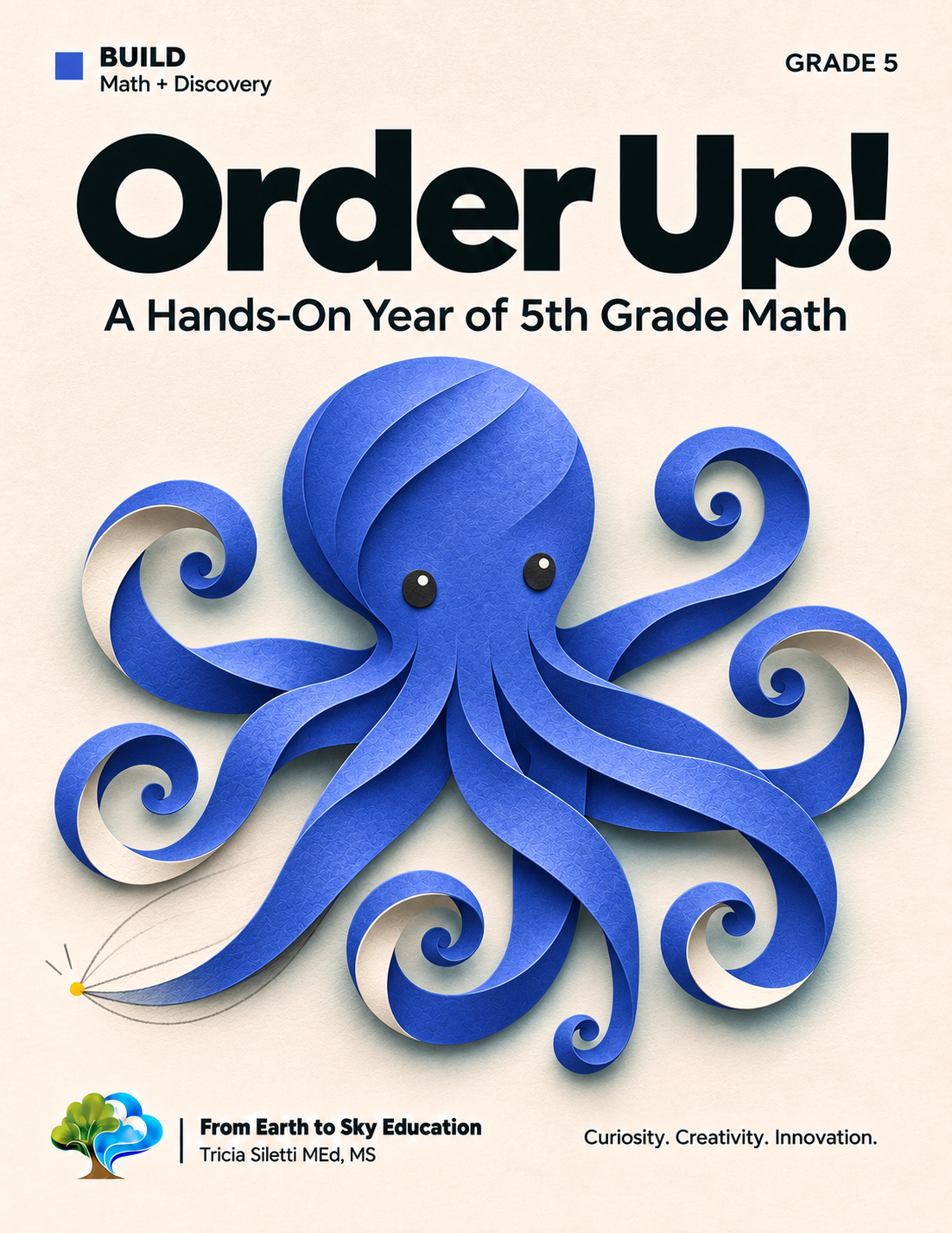
Order Up! A Hands-On Year of 5th Grade Math Full-year course | 36 weekly lessons | Grade 5 (ages 10 to 11) | Facilitator Guide + Student Workbook
$75.00
Fifth grade is the year math grows up. Fractions and decimals stop being pictures on a worksheet and start doing real work, multiplication and division stretch into big and beautiful numbers, and children meet exponents, the coordinate plane, volume, and their very first algebra. It is a hinge year, and it is often the year a child quietly decides whether they are "a math person." We want your child to decide yes, and to have fun doing it.
Order Up! is a complete fifth grade math course built the From Earth to Sky way. Every week begins with something your child can touch: a paper brownie pan cut into partial quotients, a napkin folded into fraction products, a stack of pennies averaged into a mean, a box crammed with sugar cubes. Your child discovers each idea first and learns its name second. Then they practice it, play a game with it, make something with it, talk it through in a Socratic Circle, and write about it in a math journal.
Over thirty-six weeks your child will read, write, and compare numbers to the millions; use powers of ten and exponents; multiply multi-digit numbers fluently and divide by two-digit divisors; find factors, primes, and prime factorizations; write and evaluate expressions with the order of operations; add, subtract, multiply, and divide fractions and mixed numbers (including multiplication as scaling and dividing with unit fractions); read, compare, round, and compute with decimals to the thousandths; solve money, unit price, and budget problems; convert measurements; graph data and find the mean, median, mode, and range; graph patterns on the coordinate plane; classify shapes; and find area and volume. The year ends at The Food Truck Festival, where your child opens their own pretend food truck and presents a final project of their choice.
Otto is a cheerful octopus in a gold chef's hat who runs a food truck called The Eight-Arm Kitchen in the seaside town of Port Pepper. He flips pancakes, rings up orders, writes the menu, and juggles lemons, all at once, with all eight arms. That is exactly why he makes one math mistake every week. His friends are Pearl the sea otter (who runs the register and keeps the books), Captain Gull (who delivers supplies and measures everything), Professor Shelly (a wise sea turtle who loves maps and shapes), and Hank the hermit crab (who keeps moving into bigger boxes and cannot stop talking about volume).
Every week, Otto sends your child an Order Slip with exactly one mistake hidden inside. Your child finds it on Day 1, and on Day 4 they Send It Back with a kind letter that fixes the mistake with proof. Thirty-six slips later, your child checks every answer, including their own, and explains their thinking with confidence.
Every day starts with the Daily Special, a five to ten minute mental math warm-up. Every week ends with a Practice Set: twelve Quick Bites (many with pictures of grids, models, number lines, graphs, coordinate planes, and cube buildings), five funny Order Problems set in Port Pepper, a Chef's Challenge, and Leftovers, spiral review from earlier weeks so September's learning is still there in May. Every answer is in the Facilitator Guide.
In the Food Truck File, your child dreams up a food truck in September and builds it all year: stocking supplies with multi-digit multiplication, portioning with division, writing a day's plan as expressions, mixing a signature fraction recipe and scaling it for a crowd, pricing the menu with decimals, building a budget with income, expenses, and taxes, surveying customers and graphing the results, mapping a route on the coordinate plane, designing a floor plan with area, and packing storage boxes by volume. Then the truck opens for business at the Food Truck Festival.
Learning shows up in the Math Journal, the Socratic Circle, the Practice Sets, Send It Back, and twelve hands-on Show Me checkpoints, one per unit, where your child shows and tells while you listen. One simple rubric runs through everything: Not Yet, On My Way, Got It, I Can Teach It. The Taste Test at midyear and the Food Truck Festival at year end give your child two big chances to teach what they know.
The Facilitator Guide, 310 pages. You do not need to be a "math person." Every lesson gives you the big idea, why it matters, standards and IXL skills, objectives with Bloom's Taxonomy levels, the Daily Special with answers, Otto's slip with the mistake explained, what to set out and say, what usually happens, three worked examples, a game with complete rules, a creative project, a Socratic Circle plan with a full Bloom's question ladder, all eight multiple intelligences, support and stretch ideas, online resources, books, games, field trips, a worldschooling connection, and complete answers. You also get a welcome letter, a readiness check, pacing options, a guide to leading Socratic Circles, assessment without tests, a year at a glance, a materials and safety list, the Food Truck File plan, a glossary, report card language, field trips and worldschooling in one list, further learning, and Common Core, California, and national standards with a full IXL skill map.
The Student Workbook, 262 pages. Otto's Order Slips, Discover pages, vocabulary and Chef's Notes, Try It, game score sheets, Create pages, My Two Questions, Math Journal and Send It Back pages, 36 Practice Sets, 12 Food Truck File pages, 12 unit check-ins, a Daily Special tracker, a final project planner, a certificate, and a 12-page printable Toolkit (place value chart, fraction strips, decimal grids, coordinate grid, grid paper, isometric dot paper, a box net, play money, a conversion cheat sheet, a floor plan grid, a menu board, and order tickets).
Mostly what is already in your home: dried beans, dice, a deck of cards, index cards, coins, clay or play dough, paper plates and cups, string, tape, a ruler, measuring cups, a kitchen scale, a few small boxes, and sugar cubes. Plan on about $25 to $60 from a standing start. Screens are optional; IXL, Khan Academy, and the free Math Learning Center apps are suggested as extras, never required.
The child who is ready for big fifth grade ideas but still learns best with their hands. The child who has decided they are "bad at math" and deserves a fresh start. The entrepreneur who would rather run a food truck than fill a worksheet. And the family stepping away from workbook-only math who still wants a full, standards-aligned year with plenty of practice. When the year is done, your child will not only know their fifth grade math; they will know they are a math person, and that confidence will carry them into middle school and beyond.