 Image 1 of 1
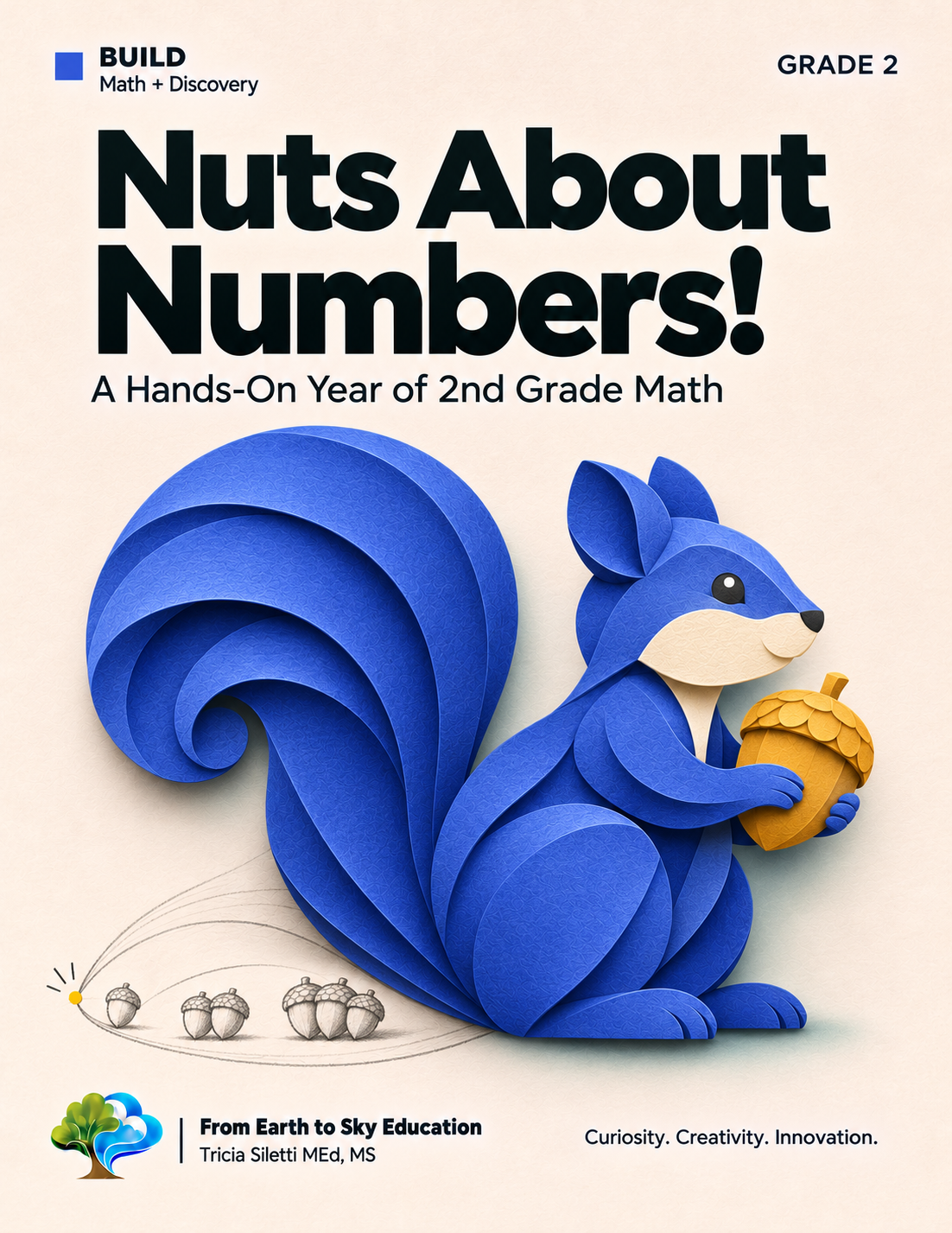
A Hands-On Year of 2nd Grade Math Full-year course | 36 weekly lessons | Grade 2 (ages 7 to 8) | Facilitator Guide + Student Workbook
$75.00
Second grade is the year numbers get big. Suddenly your child is reading 347, adding 58 + 26 in their head, counting change, and wondering why the clock has two hands. It is also the year many children decide math is "hard." We would much rather they decide it is a puzzle worth cracking.
Nuts About Numbers! is a complete second grade math course built the From Earth to Sky way. Every week begins with something your child can touch: a mountain of pretend acorns to bundle into tens, a coat hanger balance that shows what the equal sign really means, a hallway number line trail, a muffin tin full of arrays, a paper plate clock mystery. Your child discovers each idea first and learns its name second. Then they practice it, play a game with it, make something with it, talk it through, and write about it in a math journal.
Over thirty-six weeks your child will count, read, and write numbers to 1,000; master hundreds, tens, and ones; add and subtract fluently within 20 and with real strategies within 100 and 1,000; solve one- and two-step story problems; explore even and odd numbers, equal groups, and arrays; measure in inches, feet, yards, centimeters, and meters; tell time to five minutes; count coins and bills and make change; build and read graphs; name flat and solid shapes; and share fairly in halves, thirds, and fourths. The year ends at The Great Acorn Festival, where your child opens their own pretend market and presents a final project of their choice.
Nutmeg is a speedy red squirrel in a gold scarf who lives in Acorn Hollow, a giant old oak tree. She bundles her acorns in tens and stores them in crates of one hundred, which makes her the perfect place value teacher. She is also a bit of a show-off, and she does math faster than she thinks. Every week she writes your child a Nutty Note about life in Acorn Hollow. Every note hides exactly one math mistake. Your child finds it, then helps Nutmeg fix it with objects, a drawing, or words. Thirty-six Nutty Notes later, your child checks every answer, including their own.
Every day starts with the Nut Cracker, a five to ten minute warm-up. Every week ends with a Practice Set: twelve Quick Cracks, five silly story problems, Nutmeg's Challenge, and Look Back review so September's learning is still there in May. Every answer is in the Facilitator Guide.
In the Acorn Market Project, your child designs, names, stocks, prices, surveys, measures, and decorates their own pretend market stall, one step at a time. It opens for business at the Great Acorn Festival, complete with paper money, making change, and a spend, save, and share jar.
Learning shows up in the Math Journal, the Socratic Circle, the Practice Sets, Help Nutmeg, and twelve hands-on Show Me checkpoints, one per unit, where your child shows and tells while you listen. One simple rubric runs through everything: Not Yet, On My Way, Got It, I Can Teach It.
The Facilitator Guide, 193 pages. You do not need to be a "math person." Every lesson gives you the big idea, standards and IXL skills, Nutmeg's note with the mistake explained, what to set out and say, what usually happens, three worked examples, a game with full rules, a creative project, a Socratic Circle plan with a Bloom's Taxonomy question ladder, multiple intelligences, differentiation, online resources, books, outings, worldschooling ideas, and complete answers. You also get a readiness check, pacing options, a guide to leading Socratic discussions with young children, assessment without tests, a year at a glance, a materials list, a glossary, report card language, field trips, further learning, and Common Core, California, and national standards.
The Student Workbook, 231 pages. Nutty Notes, Discover pages, Build and Try It pages, Play and Create pages, My Two Questions, Help Nutmeg, journal pages, 36 Practice Sets, 12 unit check-ins, 12 coloring pages, a Nut Cracker tracker, a final project planner, a certificate, and a 17-page printable Toolkit (hundred charts, number lines, ten frames, a place value mat, paper base-ten blocks, digit cards, paper coins and bills, a clock face, a calendar grid, graph paper, paper rulers, shape cards and nets, fraction strips, spinners, a score sheet, and an Acorn Bank Record).
Mostly what is already in your home: dried beans or pom-poms, craft sticks, rubber bands, dice, a deck of cards, real coins, clay or play dough, paper plates, an egg carton, a muffin tin, a ruler, and a yardstick or meter stick. Plan on about $20 to $50 from a standing start. Screens are optional; IXL, Khan Academy, and the free Math Learning Center apps are suggested as extras, never required.
The child who counts everything in sight. The wiggly learner who needs to move, build, and talk to understand. The family stepping away from workbook-only math who still wants a full, standards-aligned year with plenty of practice. When the year is done, your child will not only know their second grade math; they will know they are a math person.